
Frost RadarTM for
Environmental Resilience
Building Environmental Resilience: Why It Matters and How the Environment Resilience Radar Measures It
As climate change accelerates, ecosystems degrade, and natural resources face increasing pressure, countries must adapt not only to mitigate environmental risks but also to sustain long-term economic growth, public health, and national stability. In this context, the Environment Resilience Radar provides a comprehensive framework for evaluating both the present state and future readiness of countries across two dimensions: environmental growth and environmental innovation. This blog outlines the rationale for environmental resilience, examines global trends in environmental sustainability and green innovation, and explains the methodological foundation of the Environment Resilience Radar, concluding with insights into emerging global leaders from the 2025 analysis.
The Strategic Imperative for Environmental Resilience
Environmental resilience refers to the capacity of natural and human systems to withstand, adapt to, and recover from environmental stressors. These stressors include climate-driven events such as heatwaves, droughts, floods, and storms; chronic environmental degradation; declining biodiversity; and pressures from rapid urbanization and resource scarcity. Countries that fail to build resilience face mounting economic losses, infrastructure risks, public health burdens, and widening inequality.
Developing environmental resilience is therefore not simply an ecological concern but a national development priority. The World Bank estimates that climate change could push over 130 million people into poverty by 2030 if resilient governance frameworks are not strengthened. For this reason, resilience has become integral to national planning, international climate finance, and bilateral and multilateral development programs.
Environmental Growth and Innovation: Global Trends and Their Importance
The global trajectory in environmental performance indicates both progress and persistent gaps. Recent energy trends show the scale of transition. According to the International Renewable Energy Agency (IRENA), renewable energy sources accounted for approximately 30 percent of global electricity generation in 2023, representing a significant increase from previous years. The International Energy Agency (IEA) reported that in 2024, renewable and nuclear power together generated over 40 percent of global electricity, marking the first time low-carbon sources reached such a share in modern electricity systems. Solar photovoltaic and wind technologies were the primary drivers of this expansion, constituting most of the global electricity growth in that year.
Forest and land-use trends, critical indicators of ecological stability, show structural changes as well. The Food and Agriculture Organization’s Global Forest Resources Assessment 2025 indicates that forests currently cover about 4.14 billion hectares, or roughly 32 percent of global land area. Importantly, the rate of net forest loss has declined from more than 10.7 million hectares annually in the 1990s to approximately 4.12 million hectares per year between 2015 and 2025. Although global deforestation persists, this slowdown reflects policy reforms, conservation investments, and growing adoption of sustainable land governance practices.
These data highlight the need for comprehensive measurement tools that capture both the current environmental status of countries and their capacity for long-term innovation. The Environment Resilience Radar is designed precisely to fill this analytical gap.
The Environment Resilience Radar: Structure and Methodology
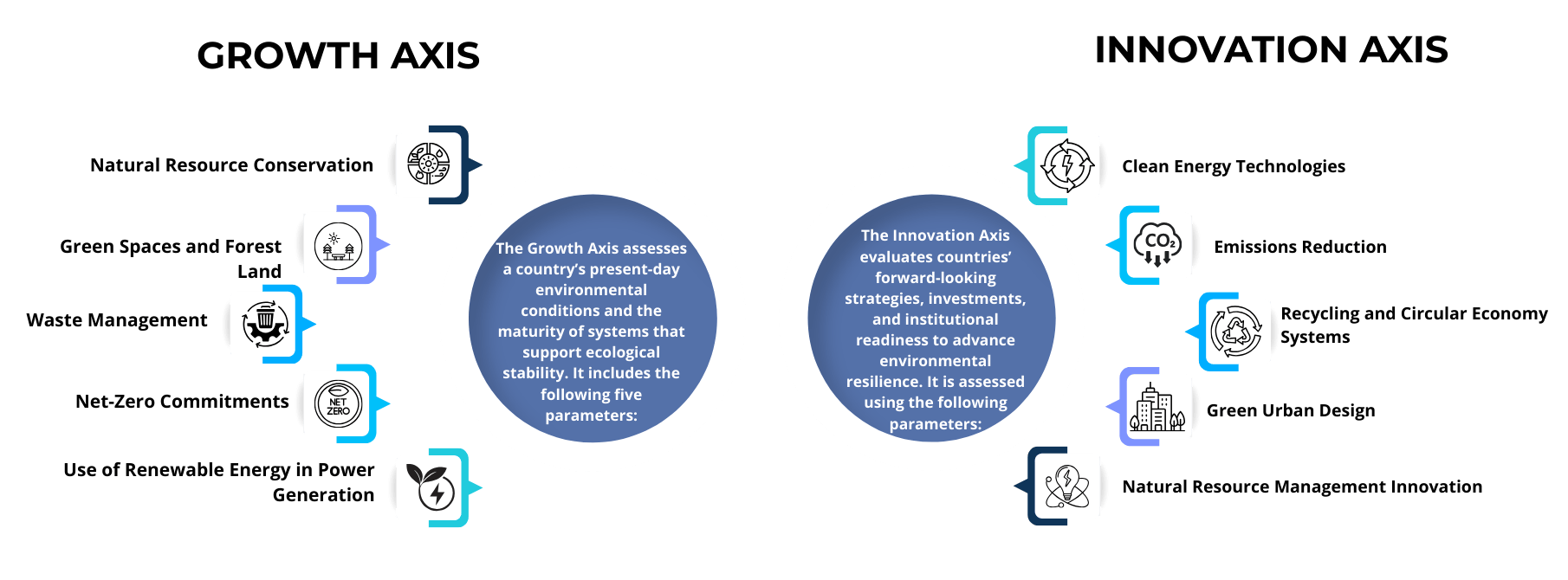
How can you leverage Frost Radar?
As a Donor
Focus your contribution on socio-economic priority areas to help improve the future growth potential of countries
As a Donor
Engage with policy-makers and Organizations to co-create srategy and policy for countries with a low innovation score and rank
As a Volunteer
As a Volunteer
Global Leaders in Environmental Growth and Innovation
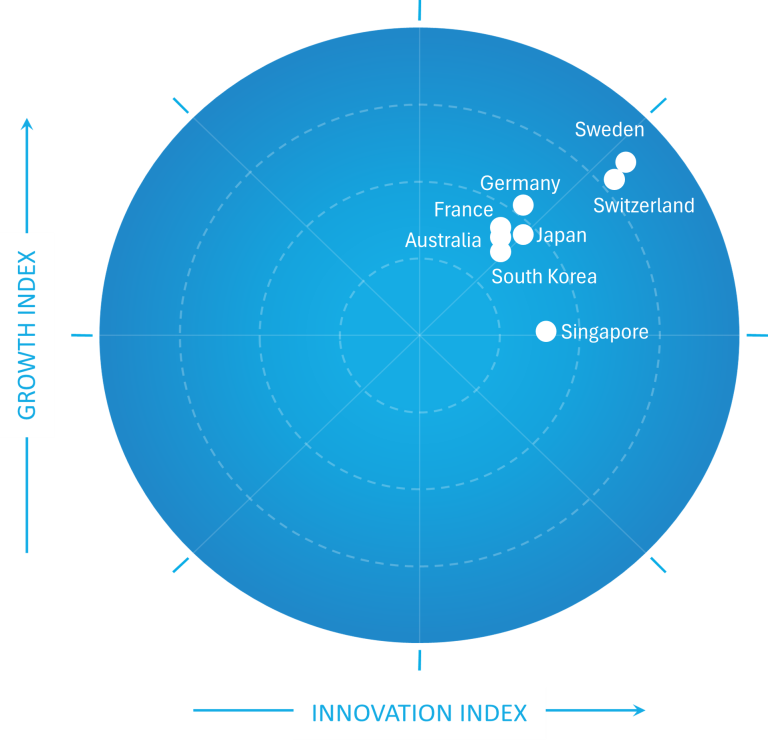
The 2025 Environment Resilience Radar identifies a set of leading countries across individual parameters and overall performance.
In terms of renewable energy integration, Switzerland ranks highestr, reflecting its advanced hydropower and clean energy systems. France leads the Net-Zero Commitments category with a perfect score due to its robust legislative framework, clear timelines, and stringent reporting mechanisms. In waste management, South Korea ranks highest, consistent with its globally recognized recycling and waste-to-energy systems. South Korea also leads in Green Spaces and Urban Forestry, with substantial forest coverage and urban greening initiatives.
Overall Growth scores show Germany as the most balanced performers across the five Growth parameters.
In Innovation, Switzerland leads in Clean Energy Technologies. Sweden demonstrates exceptional leadership in both Emissions Reduction and Natural Resource Management, attributable to its long-standing decarbonization policies and ecosystem stewardship models. Switzerland also excels in Recycling and Circular Economy innovation. Singapore reflects global leadership in sustainable and compact city planning.
The highest overall Innovation scores belong to representing countries at the forefront of future-oriented environmental transformation.
Combining both axes, the top five countries in environmental resilience are Japan, Germany, Switzerland, Sweden, and Australia. These countries demonstrate a combination of strong environmental systems and forward-looking innovation strategies, positioning them as global leaders in resilience.
Conclusion
Environmental resilience is central to national sustainability, economic stability, and social well-being. As global indicators show, progress is being made in renewable energy adoption, forest conservation, and environmental innovation, but gaps persist. The Environment Resilience Radar offers a rigorous framework for assessing both the present and future dimensions of environmental performance. By integrating measurable indicators and a transparent scoring methodology, the Radar enables governments, researchers, and investors to identify strengths, diagnose vulnerabilities, and prioritize strategic interventions.
In a world where environmental risks increasingly shape geopolitical and economic realities, such multidimensional tools are essential. The Environment Resilience Radar not only evaluates where countries stand today but also illuminates the pathways toward a more resilient and sustainable future.