When a missile strikes a facility thousands of miles away, the “butterfly effect” is not just a metaphor; it is a line item on a global balance sheet. From the fuel in our cars and the microchips in our computers to the very food on our plates, modern warfare does not stay confined to the battlefield. It travels through systems, crossing oceans and borders, ultimately landing on our doorsteps and in our wallets. In an era of hyper-optimized supply chains, this is the global domino effect of war: an invisible, systemic shockwave that turns geopolitical tension into a tangible burden on our daily lives.
In line with the global priorities of economic stability, secure infrastructure, and resilient supply chains, this article examines how modern conflicts trigger global economic shockwaves and why governments and businesses must prepare for them.
1. Energy
Energy markets react quickly and sharply to geopolitical conflicts because oil and gas supply chains are concentrated in specific regions. In early March 2026, strikes involving the US, Israel, and Iran escalation, Brent crude rose 4.7% in a day to $81.4/barrel and later 12% above pre-conflict levels, while U.S. diesel jumped 10% and gasoline 4% (Reuters, 2026). Historically, the pattern is similar: the 2022 Russia–Ukraine war drove EU gas prices up 180% and oil prices by 40%, highlighting energy as the primary channel transmitting inflation and economic uncertainty (European Central Bank, 2022). But these shocks do not remain confined to commodity markets, they are rapidly absorbed and amplified by global financial systems.
2. Financial Markets and Global Investment
Financial markets quickly reflected rising geopolitical risk during the 2026 Gulf escalation, with the U.S. dollar index hitting a multi-month high and gold prices reaching record levels, signaling a shift toward safe-haven assets (Reuters, 2026). Global equities weakened, with the MSCI World ex-USA dropping sharply, although U.S. markets held up relatively well due to gains in energy stocks. Commodity prices generally rose, heightening inflation expectations.
These movements reflect more than short-term volatility; they signal a reallocation of global capital:
Investors pull back from risk assets
Bond markets experience volatility
Capital flows shift across currencies and regions
This financial tightening does not stay abstract. It directly affects trade, investment, and business confidence, especially in sectors dependent on global movement of goods.
That is where the next layer of disruption emerges: logistics.
3. Logistics Disruption
Global logistics networks are highly vulnerable to geopolitical disruptions, as both maritime and air transport depend on secure and predictable routes. Since late 2023, as Red Sea disruptions forced Asia to Europe shipping to reroute, increasing transit times by 10 to 14 days, while the Shanghai Containerized Freight Index surged 114% and container rates rose 8% to Europe and 43% to the U.S. West Coast, with Suez traffic falling from 4.0 to 1.7 million tons per day (Atlas Institute for International Affairs, 2025; Reuters, 2024). Air transport faced similar strain, as rerouting increased fuel use and pushed jet fuel prices from $85 to $90 up to $150 to $200 per barrel, resulting in higher fares and reduced connectivity (Reuters, 2026).
These disruptions reveal a critical mechanism:
When transport slows down, costs rise, not just because of higher prices, but because of increased time, greater distance, and elevated risk.
High-value sectors like pharmaceuticals are particularly vulnerable. With 35% of global trade by value moving via air, rerouting and delays threaten medicine supply chains (SupplyChainBrain, 2026). Indian manufacturers have already warned of export disruptions, highlighting how logistical breakdowns can quickly become public health risks.
As movement becomes more expensive and less reliable, the shock spreads deeper into the real economy.
4. Industrial and Consumer Spillovers
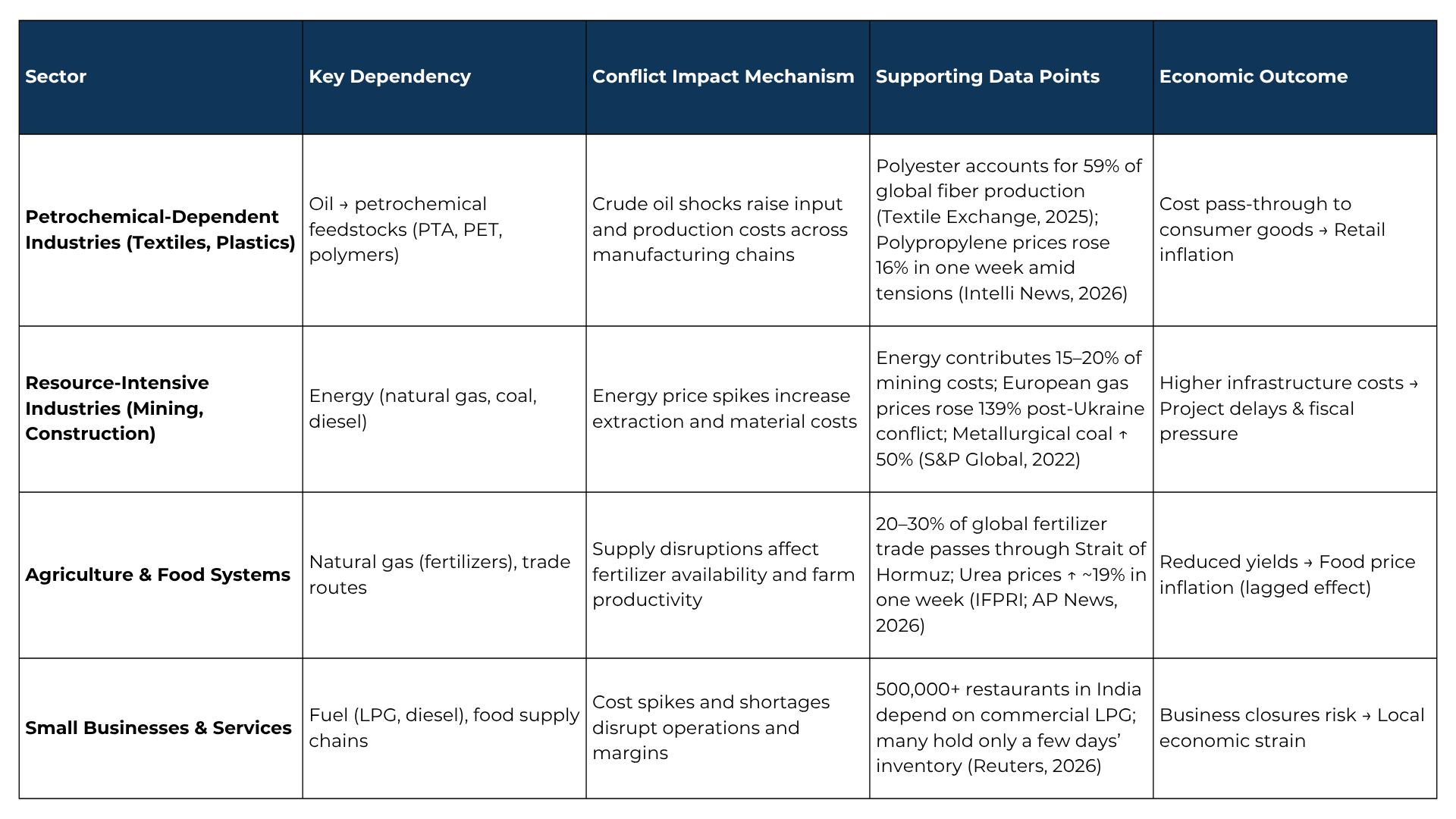
Global shocks move through production systems step-by-step, ultimately reaching consumers as higher prices, reduced services, and financial strain. The transmission of shocks across sectors can be summarized as follows:
This reflects a structural skill mismatch, in which rapidly evolving industry demands outstrip outdated curriculum and insufficient industry-academia alignment, leaving graduates with qualifications that do not match employer needs.
Conclusion
Modern conflicts no longer remain confined to battlefields, they propagate through energy markets, financial systems, logistics networks, and industrial supply chains. What begins as a geopolitical event quickly becomes an economic reality felt by businesses and households worldwide.
In today’s interconnected world, the true cost of conflict is not measured only in immediate damage, but in the cascading disruptions that follow, across markets, industries, and everyday life. Anticipating these shockwaves is no longer optional; it is essential for economic stability.
Blog by Samyuktha Purusothaman Nair, Research Analyst, Frost & Sullivan Institute