Imagine a job offer that doubles your family’s income. Now, imagine turning it down because the commute requires a 40-minute walk through unlit, unsafe streets. For millions of women across South Asia, this isn’t a hypothetical situation; it is a daily negotiation between opportunity and personal safety. In the long run, these individual decisions ultimately result in the region’s economic losses.
This tension between opportunity and safety exposes a deeper issue: how we measure development itself. While development is often measured in GDP or infrastructure, Amartya Sen’s Capability Approach offers a more human lens. He argues,
“Poverty is not merely a lack of money, but a lack of capabilities, the real freedom to live the life one has reason to value.”
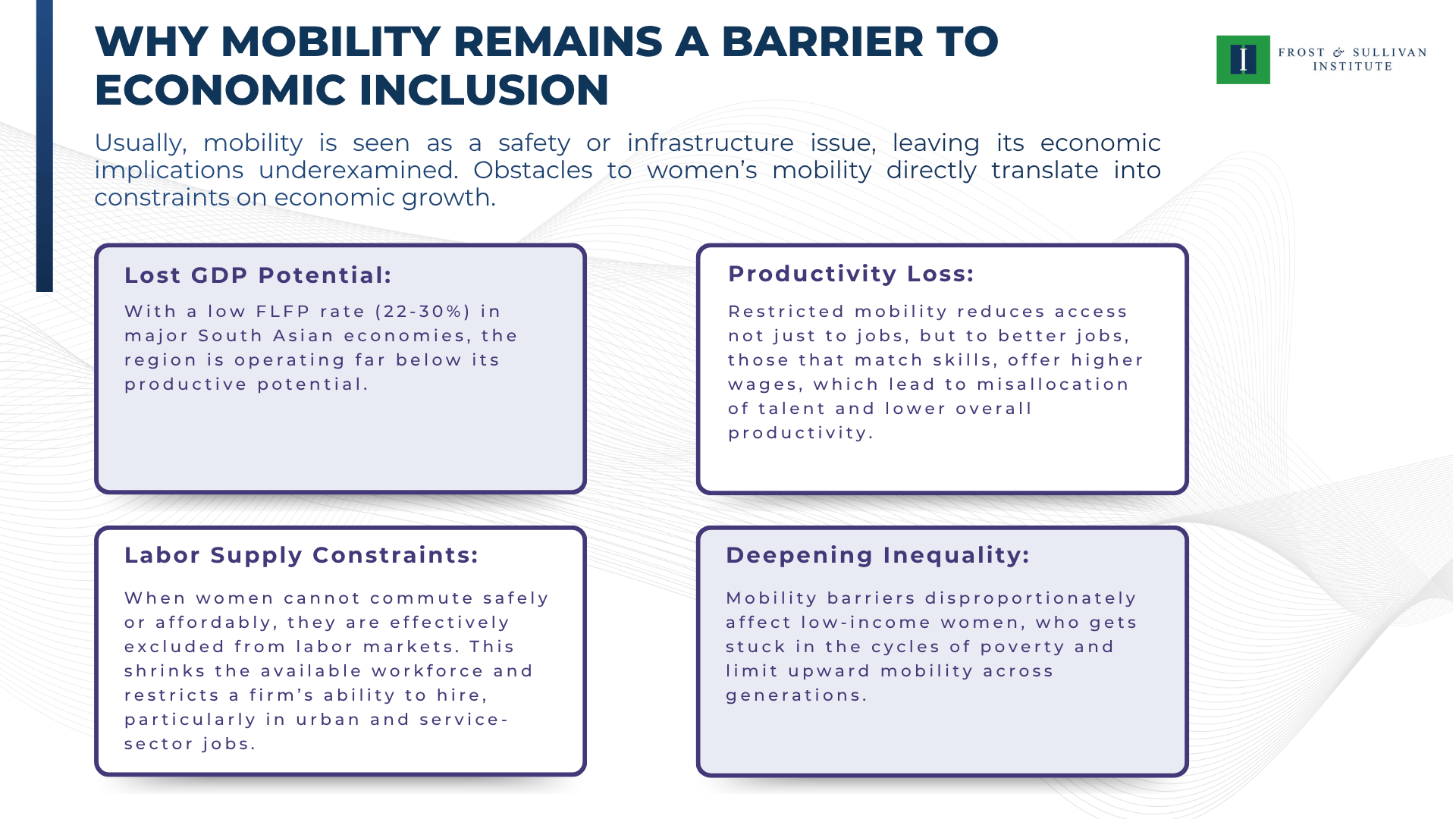
Within this framework, mobility is not just a secondary concern; it is a precondition for agency. If capability is the freedom to achieve, then transportation is the physical architecture of that freedom. When a woman’s movement is restricted, so are her opportunities to study, work, access healthcare, and participate fully in public life. Low female labor force participation in South Asia is not just a social issue; it represents a structural economic constraint.
The Scale of the Problem
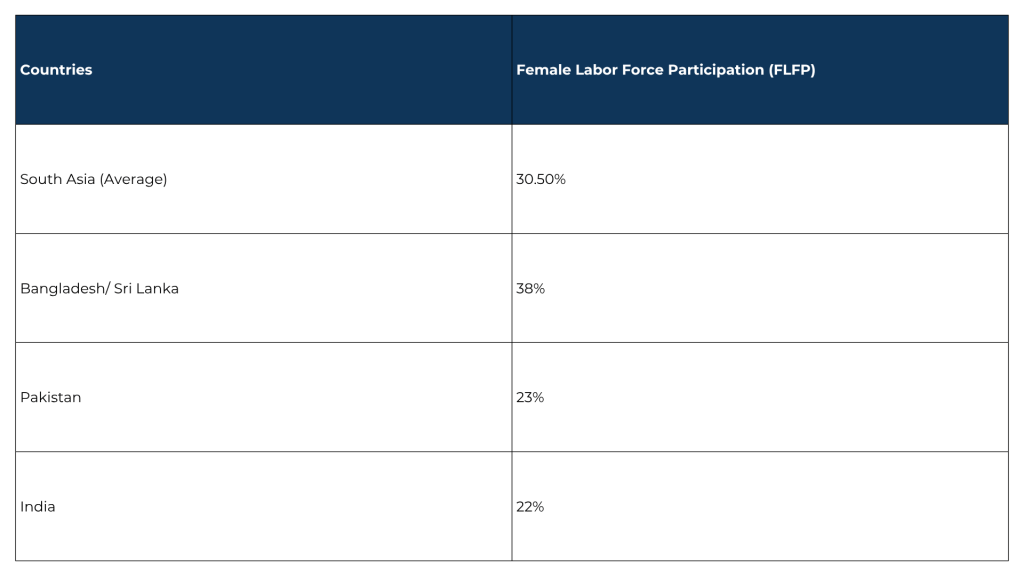
In South Asia, women still face deep inequalities when it comes to moving freely and joining the workforce. Data from ILOSTAT 2023 shows that across the region, fewer females are working compared to men, which is far lower than the global average:
These figures reveal not just an economic gap, but a systemic exclusion of women from the workforce. Only around 3 in 10 women take part in work life, while most men do. Transport is a critical, underexamined driver of this gap: the International Labor Organization estimates that the lack of adequate transport alone reduces the probability of women working by 16.5%.
A systematic review of six South Asian nations, like India, Bangladesh, Pakistan, Nepal, Sri Lanka, and Afghanistan, found that women’s mobility is constrained by a combination of factors such as:
Inadequate infrastructure
Sexual harassment in public spaces
Gaps in legal protection
Mobility alone does not guarantee safety. When using buses or trains, their sense of danger stays high despite access. In global surveys, women are 10% and 6% more prone to fear riding subways and city buses, respectively, compared to men. The difference is much more evident in crowded networks across the region.
Economic Participation Jumps: The World Bank emphasizes that improving women’s access to work could significantly boost economic growth. Better transport options can potentially add thousands of women to the workforce. Ensuring safe and accessible mobility is therefore critical to unlocking women’s full economic capability and closing persistent gender gaps.
Education Advances: Mobility constraints significantly affect girls’ access to education, particularly beyond primary levels. Across the region, unsafe or distant travel routes often lead families to withdraw girls from school. Countries like Nepal and Bangladesh, showed an increased girls’ enrollment and retention rates with improved connectivity and a higher rate of dropouts where the connectivity is inefficient. Mobility thus determines not only access to schooling but also long-term human capital development.
Greater Autonomy: Beyond economics, reliable transit grants women the fundamental agency to exist in public spaces. Research by UN ESCAP on Bangladesh highlights how safe mobility gradually dismantles patriarchal restrictions, empowering women to access healthcare and social networks independently.
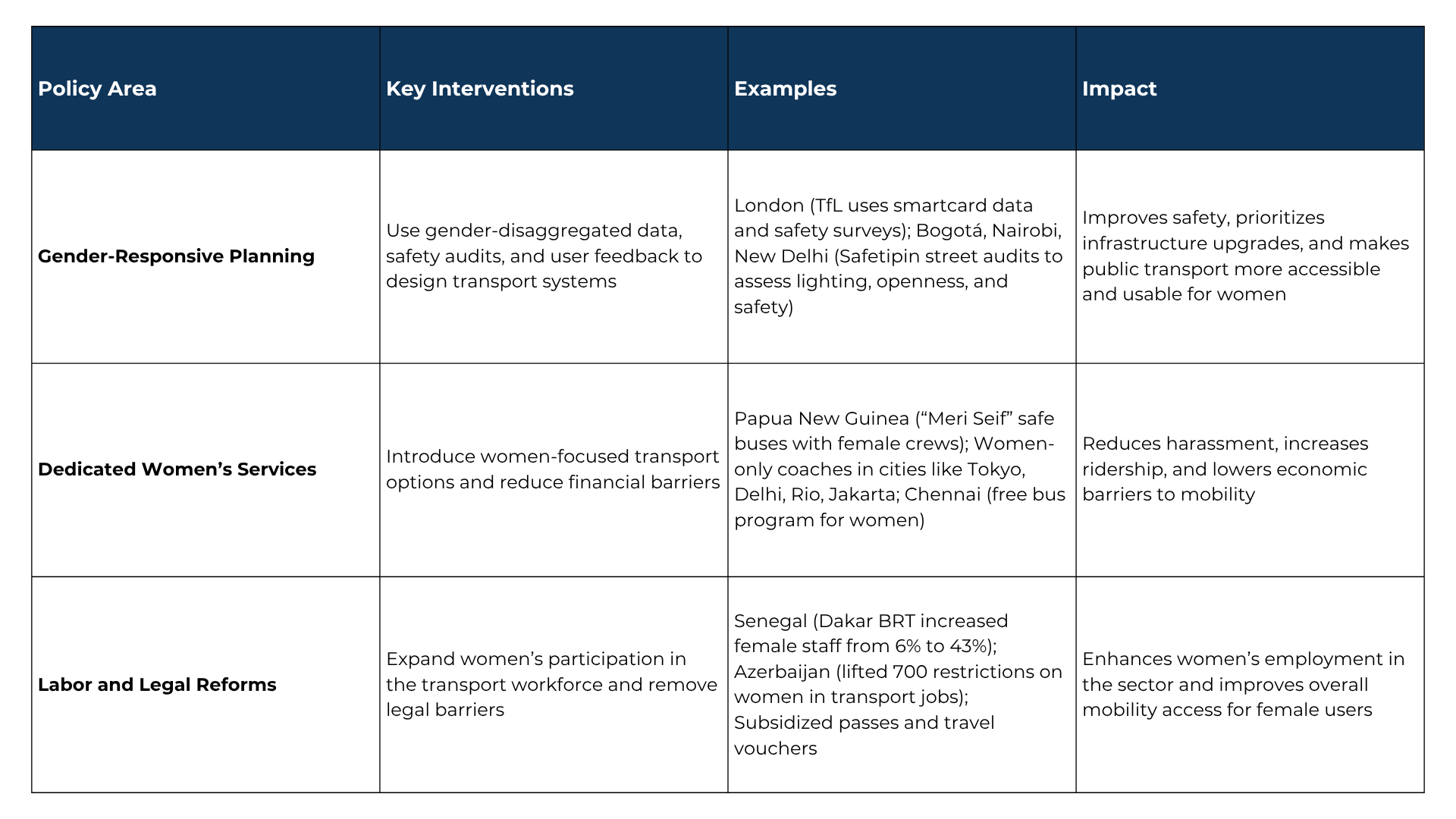
Rethinking Policy: Global Best Practices
To move forward, policymakers must shift from gender-blind to gender-responsive strategies that treat mobility as an empowerment metric.
Conclusion
Empowering women requires more than just expanding opportunities; it requires guaranteeing their physical access to them. In today’s rapidly urbanizing world, as South Asia focuses on sustained growth, improving women’s mobility is not just a social good or a gendered issue; it is a strategic core economic architecture.
Countries that fail to address gendered mobility constraints are more likely to lock themselves out of significant productive gains, which shrinks their effective labor force and deepens structural inequalities.
Blog by Samyuktha Purusothaman Nair, Research Analyst, Frost & Sullivan Institute