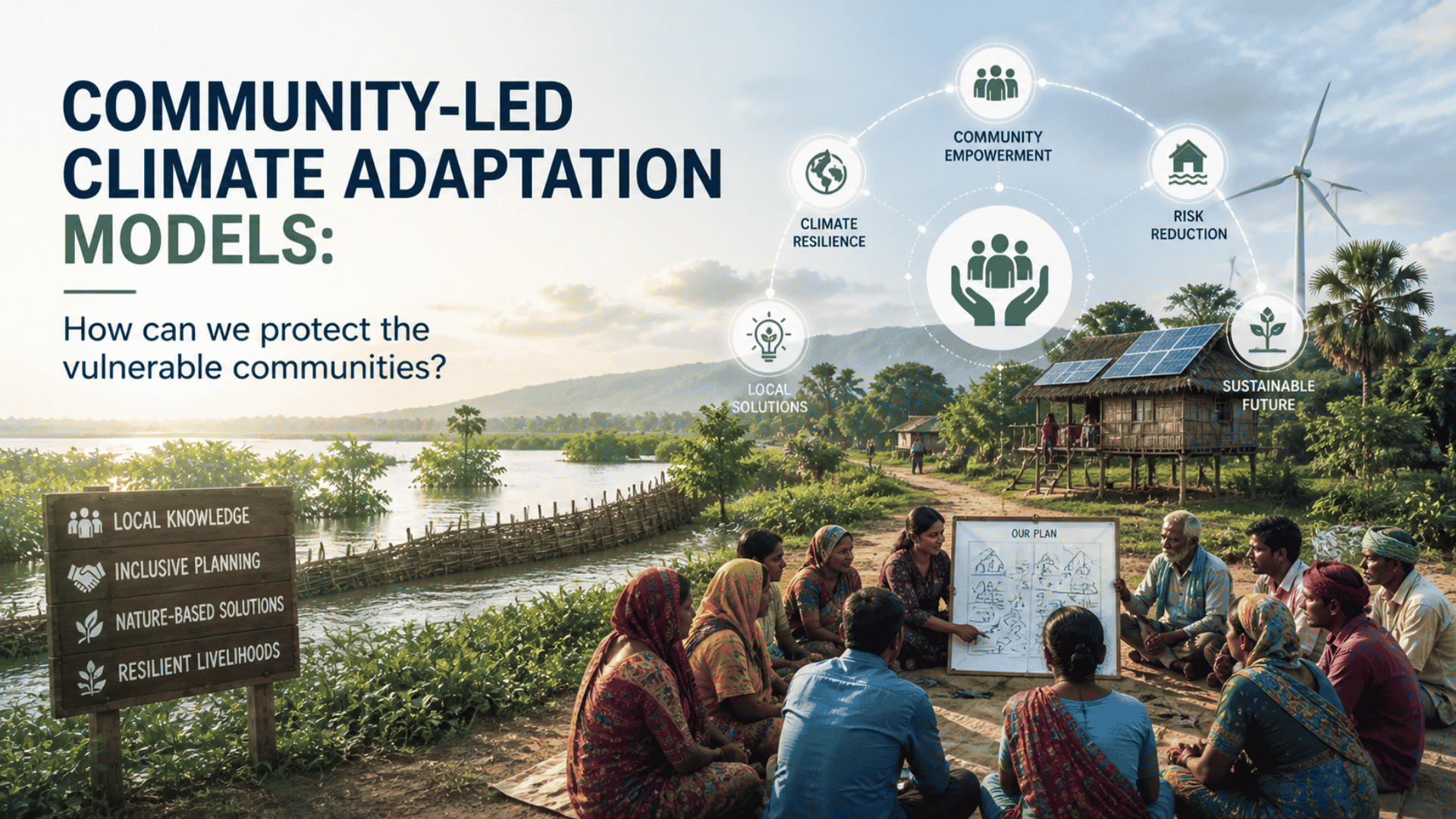
05 May Community-Led Climate Adaptation Models: How can we protect the vulnerable communities?
Climate change disproportionately affects low-income and marginalized communities around the world. Rising temperatures, shifting rainfall patterns, and more frequent extreme weather events undermine food security, livelihoods, and access to water.
Conventional top-down responses often fail to address local needs or leverage local knowledge. As a result, community-led climate adaptation models where residents themselves design, govern, and maintain adaptation systems have become strategic imperatives. These approaches are directly rooted in local experience and social networks, which makes them effective, equitable, and resilient in the face of climate disruption.
This blog examines four such initiatives around the world that illustrate how local communities are leading climate adaptation efforts in water management, resilient agriculture, risk preparedness, and ecosystem stewardship. Each example underscores the importance of centering adaptation practices around the poorest and most vulnerable.
The Watershed Organization Trust (WOTR) was established in 1993 in Maharashtra, India, evolving from the earlier Indo-German Watershed Development Program (IGWDP) launched in the late 1980s. WOTR now works across 10 states: Maharashtra, Telangana, Andhra Pradesh, Madhya Pradesh, Jharkhand, Odisha, Rajasthan, Chhattisgarh, Bihar, and Karnataka. Rural communities in drought- and water-scarce regions faced declining water tables, land degradation, and unstable agricultural production. WOTR’s watershed development model combines community mobilization with sustainable landscape interventions to address poverty and water insecurity together.
Over nearly three decades of implementation, WOTR initiatives have regenerated more than 2.22 million hectares of degraded landscapes, created more than 158 billion liters of potential water-harvesting capacity, and improved the livelihoods of more than 6.93 million people across 7,124 villages. Measures such as rainwater harvesting, soil retention structures, and triple-cropping systems have significantly increased agricultural productivity and income for marginalized farmers.
Participatory watershed management shows how community ownership of natural resource governance can reduce vulnerability to drought, improve water security, and drive lasting socioeconomic improvements.
2. Floating Agriculture (Baira/Baira Gardens) – Southern Bangladesh
Floating agriculture, known locally as baira or dhap farming, is a centuries-old practice in the flood-prone wetland districts of Gopalganj, Pirojpur, and Barisal in southern Bangladesh. It has been practiced for hundreds of years, and in 2015, FAO recognized it as a Globally Important Agricultural Heritage System (GIAHS) after the Ministry of Agriculture nomination. This highlights its adaptive value in wetlands where conventional farming fails. In areas where land becomes submerged for extended periods due to seasonal flooding, landless and vulnerable farmers invented floating garden platforms constructed from water hyacinth and organic matter so they could continue cultivating vegetables even when croplands were underwater.
Floating agriculture has enhanced food and nutritional security among landless households that otherwise would lack productive land during flood seasons. It also provides income-generating opportunities, especially for women and marginalized households, while repurposing invasive aquatic plants for productive use. Indigenous and traditional practices like floating agriculture can offer sustainable and cost-effective climate adaptation models, especially where environmental conditions render conventional agriculture untenable.
3. Community-Based Early Warning Systems – Infanta & General Nakar, Philippines
In the typhoon-vulnerable municipalities of Infanta and General Nakar in Quezon Province, Philippines, community-based early warning systems (EWS) were developed in response to repeated flooding and typhoon impacts, particularly following the devastating floods of 2004 that killed over 1,000 in the area. Local disaster councils worked with community groups to install manual rain gauges, water level monitoring stations, two-way radios, and contingency plans to improve preparedness and communication.
These areas faced recurring hazards from tropical cyclones and floods. Conventional top-down warning systems often failed to reach vulnerable households in time, prompting local leaders and community organizations to co-design localized systems that could deliver actionable alerts and preparedness activities with community buy-in.
Community-level monitoring and communication capacity strengthened preparedness, improved evacuation coordination, and enhanced local disaster risk management. Training of local disaster councils and integration with scientific forecasting agencies such as PAGASA helped bridge technical data with community action. Community-engaged warning systems reduce response times and ensure that early warnings translate into protective action, especially in the most hazard-exposed regions.
Across northern Australia, Indigenous communities and ranger groups have revitalized traditional fire management practices, also known as cultural burning or cool burning, as tools for climate adaptation and biodiversity conservation. The West Arnhem Land Fire Abatement (WALFA) project is a pioneering Indigenous-led savanna burning initiative operating across western Arnhem Land in the Northern Territory. Established in 2006, WALFA strategically conducts early dry season burns to reduce the intensity and scale of late dry season wildfires.
High-intensity wildfires have grown more frequent due to climate change and disrupted regimes of traditional fire use. The impact of WALFA has been significant and measurable in controlling this. By shifting fire patterns to cooler, patchier burns, the project has substantially reduced greenhouse gas emissions, generating verified carbon credits under Australia’s Emissions Reduction Fund. This has prevented hundreds of thousands of tonnes of carbon dioxide equivalent emissions annually, contributing meaningfully to Australia’s climate change mitigation efforts. The program has also improved biodiversity outcomes by protecting fire-sensitive ecosystems, reducing damage to critical habitats, and supporting threatened species across the Arnhem Plateau. The project provides long-term employment and training for Indigenous rangers, supports cultural knowledge transfer, which has strengthened community wellbeing, delivering both environmental and economic outcomes at scale.
WALFA is now recognized as a global model for combining traditional ecological knowledge with contemporary carbon markets to achieve climate, biodiversity, and community development benefits simultaneously.
These areas faced recurring hazards from tropical cyclones and floods. Conventional top-down warning systems often failed to reach vulnerable households in time, prompting local leaders and community organizations to co-design localized systems that could deliver actionable alerts and preparedness activities with community buy-in.
Community-level monitoring and communication capacity strengthened preparedness, improved evacuation coordination, and enhanced local disaster risk management. Training of local disaster councils and integration with scientific forecasting agencies such as PAGASA helped bridge technical data with community action. Community-engaged warning systems reduce response times and ensure that early warnings translate into protective action, especially in the most hazard-exposed regions.
Conclusion
These four community-led adaptation models demonstrate the power of locally driven climate solutions that prioritize the poorest and most vulnerable. Whether through agroforestry, water governance, climate-resilient agriculture, risk preparedness, or Indigenous land stewardship, these initiatives show that adaptation is most effective when rooted in local knowledge, inclusive governance, and sustained community engagement.
By valuing and scaling community-based approaches, planners and policymakers can both advance climate resilience and ensure that those most affected by environmental change are empowered as agents of adaptation, protecting the poorest first, not last.
Blog by Shreya Ghimire,
Research Analyst, Frost & Sullivan Institute