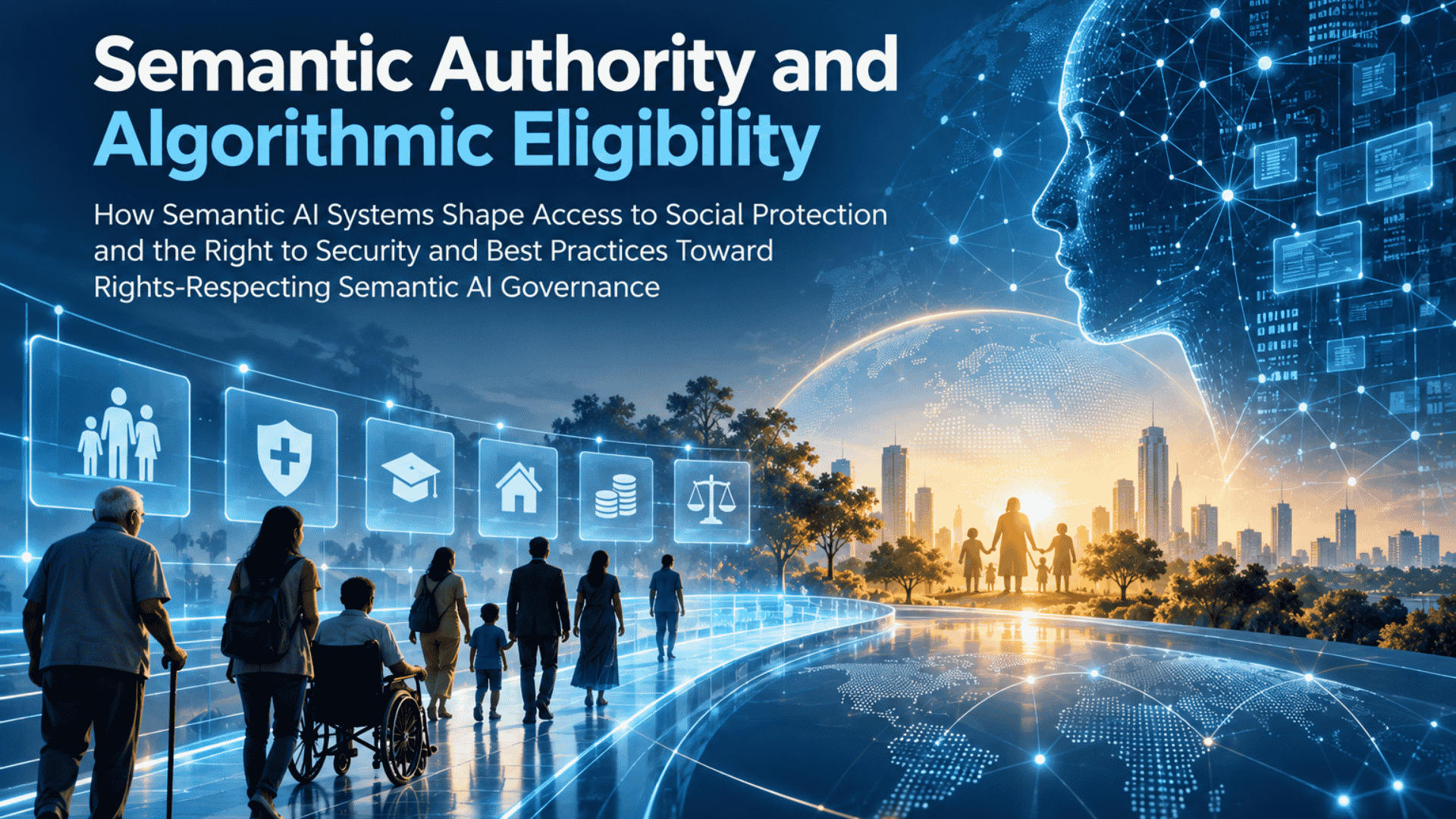
Governments increasingly use artificial intelligence to decide who receives welfare support. Some of these systems go beyond simple statistics: they use ontologies and knowledge graphs, structures that encode the meaning of legal terms such as “household,” “dependent,” “disability,” and “fraud risk.” This article calls this capability semantic AI and asks what happens to social rights when software is given the authority to define these terms. Drawing on four documented cases,
The Netherlands’ SyRI fraud-detection system, Australia’s Robodebt scheme, Michigan’s MiDAS unemployment algorithm, and India’s Aadhaar-linked food ration system, the article identifies a recurring pattern: efficiency and fraud-control goals are built directly into the system’s logic, while rights such as privacy, non-discrimination, and the right to an explanation are treated as afterthoughts, added only after litigation or public scandal.
The article argues that semantic AI does not simply apply the law; it quietly rewrites it, because whoever builds the ontology decides which facts count as evidence of eligibility or suspicion. It closes with a set of design and governance principles, disclosure of encoded rules, contestable defaults, and mandatory human review before benefits are reduced, that are intended to bring algorithmic eligibility back into line with the right to social protection.
The right to social security is not a marginal entitlement. It is written into the Universal Declaration of Human Rights and the International Covenant on Economic, Social and Cultural Rights, both of which oblige states to guarantee a minimum floor of protection against unemployment, sickness, disability, and old age. Over the past decade, the machinery that decides who receives that protection has changed quietly but fundamentally. Caseworkers reading paper files have been replaced, in whole or in part, by software that reads data instead. The UN Special Rapporteur on extreme poverty warned in 2019 that the world was “stumbling zombie-like into a digital welfare dystopia,” in which technology built to help the poor was instead being used to “surveil, target, harass and punish” them. That warning has been echoed by civil society and, in some jurisdictions, confirmed by courts…..