
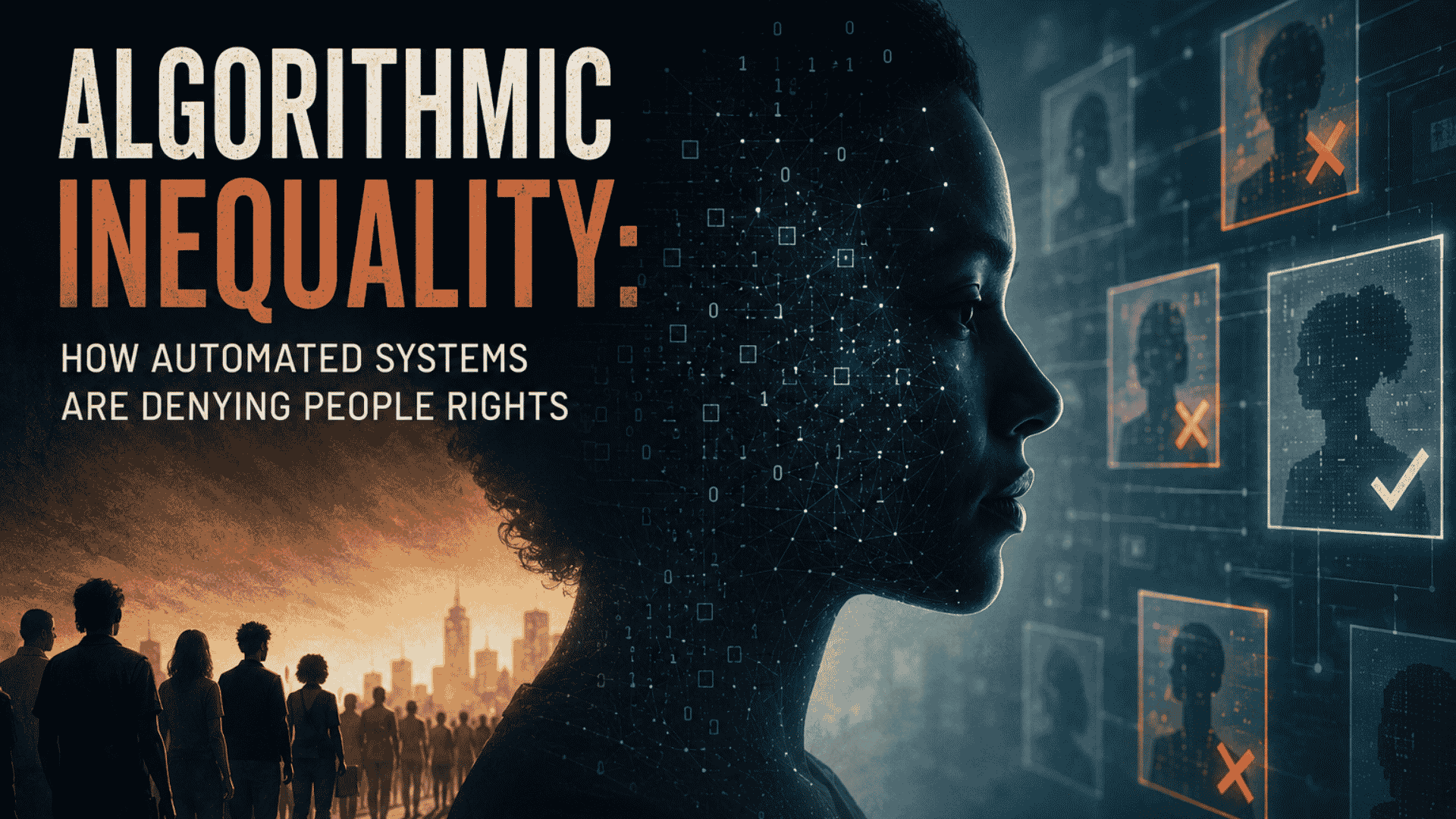
07 Jul Algorithmic Inequality: How Automated Systems Are Denying People Rights
In 2026, inequality is coded.
Across welfare offices, police departments, and financial institutions, automated decision-making systems now shape who receives public assistance, who is flagged as “high risk,” and who gains access to credit. Artificial intelligence (AI) promises efficiency, objectivity, and cost reduction. Yet, as these systems scale, a pressing question emerges: Who audits the algorithms? And how does opacity become a human rights issue?
The very tools designed to optimize governance, and markets are quietly reconfiguring rights, often to the detriment of marginalized communities.
What is algorithmic inequality?
Algorithmic inequality refers to unfair outcomes created when automated systems systematically disadvantage certain individuals or groups because of biased data, flawed models, or discriminatory decision-making processes.These systems operate under the logic of predictive analytics: large datasets, pattern recognition, and probabilistic classification. However, algorithms are not neutral. They are trained on historical data shaped by existing social inequalities. When past discrimination becomes training input, the output can perpetuate or amplify inequity.
The Rise of Algorithmic Governance
The global AI market is projected to exceed $1.8 trillion by 2030, with governments among the fastest-growing adopters. In OECD countries, over 50% of public administrations report using algorithmic tools to support decisions in social services, taxation, immigration, or law enforcement. In financial services, over 80% of credit decisions in advanced economies now rely on automated scoring models.
These systems operate under the logic of predictive analytics: large datasets, pattern recognition, and probabilistic classification. However, algorithms are not neutral. They are trained on historical data shaped by existing social inequalities. When past discrimination becomes training input, the output can perpetuate or amplify inequity.
Welfare Automation: Efficiency vs. Exclusion
Welfare systems worldwide use AI to detect fraud, assess eligibility, and allocate benefits. While digitalization reduces administrative burdens, evidence suggests that it disproportionately harms vulnerable populations.
In the United States, automated eligibility systems have led to wrongful benefit terminations affecting tens of thousands of low-income families. A study by the Georgetown Center on Poverty and Inequality found that error rates in automated Medicaid eligibility redeterminations were significantly higher for households with unstable housing or limited digital access. Similarly, in the Netherlands, the SyRI (System Risk Indication) program was ruled unlawful in 2020 for violating human rights principles due to discriminatory risk profiling. The court explicitly cited concerns over transparency and disproportionate targeting of low-income and migrant neighborhoods.
The issue is not merely administrative. When access to food assistance, healthcare, or housing is algorithmically denied, the consequences intersect with rights to social security and dignity. Automation errors are not neutral mistakes; they translate into missed meals, untreated illnesses, and eviction risks.
Predictive Policing and Racial Bias
AI-driven risk assessment tools are now embedded in policing and criminal justice systems. Predictive policing models forecast crime “hotspots,” while algorithmic risk scores inform bail, sentencing, and parole decisions.
A landmark investigation by ProPublica in 2016 found that a widely used risk assessment tool was nearly twice as likely to incorrectly label Black defendants as high risk compared to white defendants. More recent research from MIT and Stanford continues to show that facial recognition technologies exhibit significantly higher error rates, up to 10–100 times higher for women and people with darker skin tones compared to white men.
Globally, the expansion of biometric surveillance has raised alarm. The UN Special Rapporteur on Privacy has warned that predictive policing systems risk embedding structural discrimination into law enforcement practices. When historical over-policing of certain neighborhoods becomes training data, algorithms may simply automate those biases.
Credit Scoring and Digital Redlining
In financial services, algorithmic decision-making has transformed credit access. Fintech companies increasingly rely on alternative data, such as online behavior, mobile phone usage, and purchasing patterns to assess creditworthiness.
While this can expand inclusion for the “credit invisible,” it also introduces new risks. Research from the U.S. Federal Reserve suggests that algorithmic lending models, even when excluding race as a variable, can produce disparate impacts because of correlated data proxies (e.g., ZIP codes, spending patterns). A 2022 study from the National Bureau of Economic Research found that minority borrowers were charged higher interest rates in certain algorithmic mortgage models, controlling for risk factors.
Digital redlining no longer requires explicit racial categories; it emerges through pattern recognition across socioeconomic variables. For marginalized communities, algorithmic opacity obscures why loans are denied or priced higher.
When Opacity Becomes a Human Rights Issue
Opacity is not a technical inconvenience; it is a challenge of governance. Human rights frameworks emphasize accountability, non-discrimination, transparency, and remedy. Algorithmic systems challenge each of these principles.
- Accountability gaps: When decisions are automated, responsibility diffuses across developers, vendors, and public agencies.
- Lack of explainability: Complex machine learning models can be inherently difficult to interpret, even for experts.
- Limited redress mechanisms: Affected individuals often lack accessible avenues to contest algorithmic outcomes.
Globally, regulatory responses are emerging. The European Union’s AI Act classifies systems used in credit scoring, employment, and law enforcement as “high-risk,” requiring strict compliance measures. Canada’s Algorithmic Impact Assessment tool mandates the evaluation of automated decision systems in federal agencies. However, implementation gaps remain significant, particularly in low- and middle-income countries where digital infrastructure is expanding rapidly without equivalent regulatory capacity.
The World Economic Forum estimates that by 2025, over 85 million jobs may be displaced by automation, while new digital roles emerge. As algorithmic systems increasingly mediate economic participation, safeguarding rights becomes central to sustainable digital transformation.
Reclaiming Human Oversight
The core challenge is not whether AI should be used, but how. Automation can enhance efficiency and expand access when carefully designed. However, without transparency and accountability, it risks codifying inequality at scale.
Digital security must therefore encompass more than cybersecurity. It must include algorithmic integrity, ensuring systems are fair, explainable, and subject to democratic oversight. As automated systems increasingly arbitrate rights and opportunities, the question is no longer whether algorithms influence inequality. They already do. The real question is whether societies will embed safeguards strong enough to ensure that innovation advances justice rather than undermines it.
In 2026, inequality may be coded. But accountability, too, can be designed.
Blog by Shreya Ghimire,
Research Analyst, Frost & Sullivan Institute
Frequently Asked Questions
Algorithmic inequality occurs when automated systems produce unfair or unequal outcomes for individuals or groups. This often happens because AI models are trained on biased or incomplete data, use flawed assumptions, or reflect existing societal inequalities. The result can be unequal access to employment, healthcare, education, financial services, or public resources, even when decisions appear objective.
Algorithmic bias is the systematic favoritism or discrimination that occurs when an AI system consistently produces unfair outcomes. Bias can originate from historical data, data collection methods, model design, or human decisions made during development. If left unaddressed, algorithmic bias can reinforce existing inequalities and disproportionately affect marginalized communities.
AI can discriminate when it learns patterns from historical data that reflect existing social or institutional biases. For example, an AI-powered hiring system may favor applicants from certain backgrounds if past hiring data contains unequal representation. Similarly, automated systems used in lending, healthcare, law enforcement, or facial recognition may produce different outcomes for different demographic groups, even without explicitly considering protected characteristics.
Algorithms themselves do not possess legal responsibility, but the way organizations design and deploy them can contribute to human rights violations. Automated decision-making systems may affect rights related to privacy, equality, non-discrimination, due process, and access to essential services. Governments and regulators increasingly expect organizations to ensure that AI systems operate fairly, transparently, and with appropriate human oversight.
Algorithmic bias is not automatically illegal, but its consequences may violate anti-discrimination, consumer protection, employment, privacy, or human rights laws depending on the jurisdiction. Regulatory frameworks such as the European Union’s AI Act and existing equal opportunity laws require organizations to assess and mitigate risks associated with high-impact AI systems. Businesses should evaluate AI tools for fairness and legal compliance before deployment.
Organizations can reduce algorithmic bias by using diverse and representative datasets, conducting regular bias audits, testing AI systems across different demographic groups, improving model transparency, maintaining human oversight for high-impact decisions, and monitoring systems after deployment. Establishing AI governance policies, documenting decision-making processes, and complying with relevant regulations also help create more fair, accountable, and trustworthy AI systems.