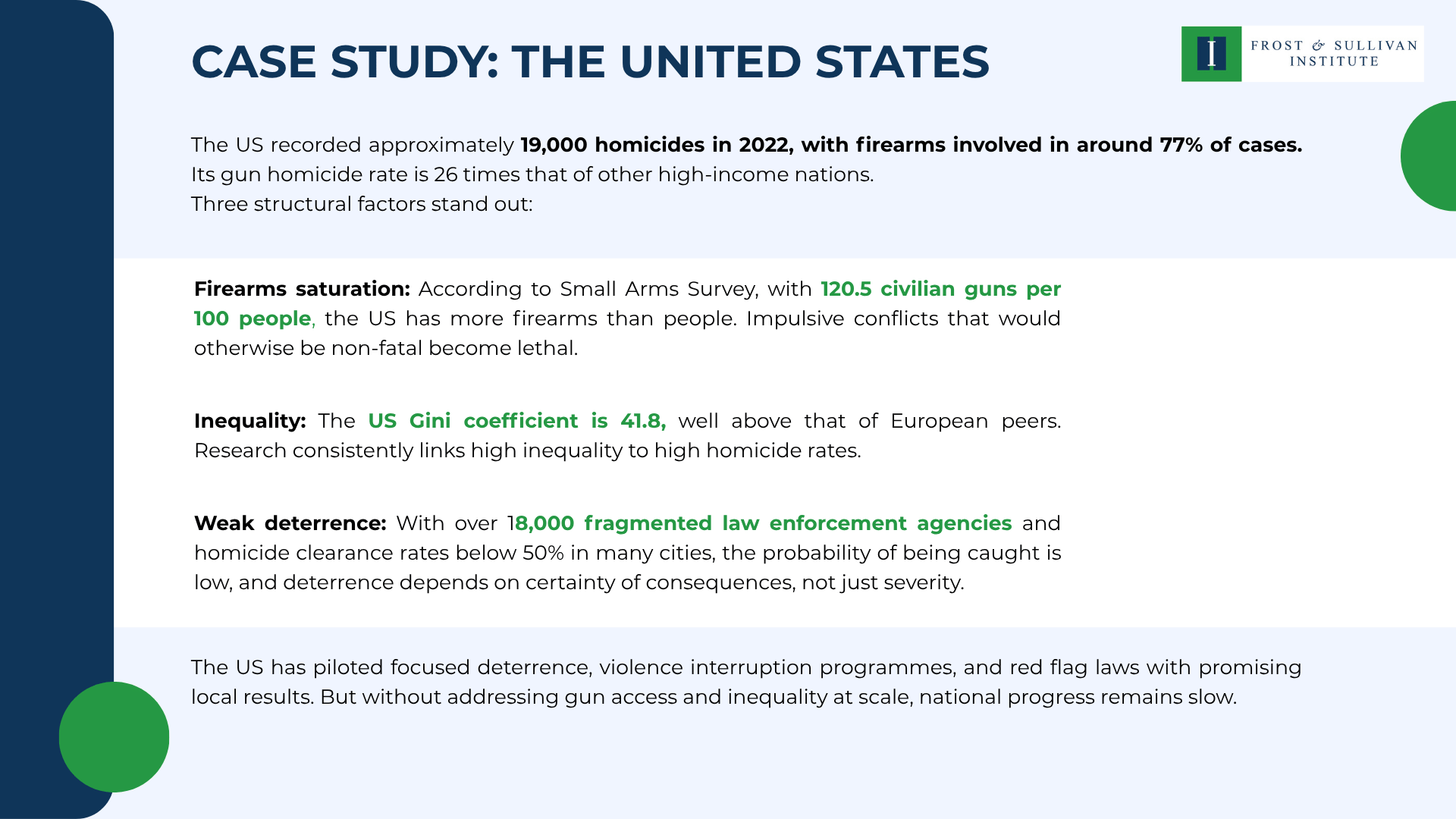
Every 68 seconds, someone on this planet is killed deliberately and unlawfully. According to the UN Office on Drugs and Crime (UNODC), intentional homicide claims around 440,000 lives a year, more than armed conflict and terrorism combined, averaging 52 deaths every hour. What makes this toll so striking is that it is largely preventable. And no country makes that case more powerfully than Singapore, which recorded a homicide rate of just 0.07 per 100,000 in 2023, while wealthy, stable peers like the United States registered 5.0.
The scale of this largely preventable loss raises difficult questions about the balance between security and liberty. How much freedom would societies be willing to trade for greater safety, and where should the line be drawn between public security and individual rights when policies such as surveillance, strict enforcement, and social control can dramatically reduce violence? This blog examines what drives intentional homicide, why the United States continues to struggle with it, and what Singapore’s record teaches the world.
What Is Intentional Homicide?
The UNODC defines intentional homicide as “the unlawful death inflicted upon a person with the intent to cause death or serious injury”, covering murder, fatal domestic violence, and gang killings, but excluding conflict deaths and accidents. Homicide is the most reliable cross-country crime indicator we have: a deceased body is far harder to conceal or misclassify than a theft or assault, which is why criminologists use homicide rates as a proxy for a society’s overall institutional health.
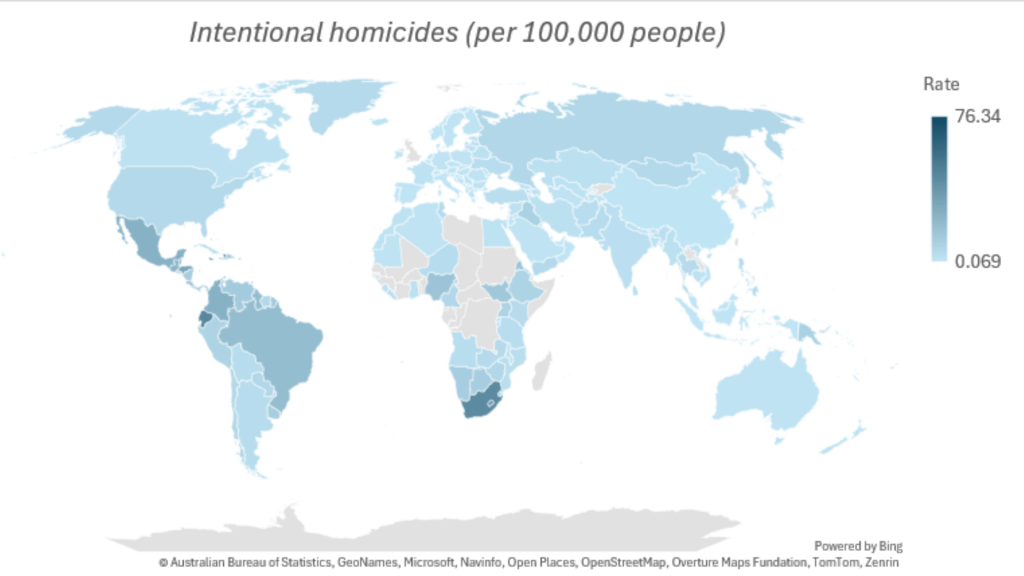
The map highlights a stark geographic disparity in homicide rates, with the highest levels concentrated in sub-Saharan Africa and Latin America. South Africa records 43.5 homicides per 100,000 people, Jamaica 40.1, Honduras 35.8, and Venezuela 36.7, far above the global average of 5.2 per 100,000. Mexico also shows a relatively high rate of 19.3 per 100,000. The most important observation from this map is not that developing nations suffer high homicide, but that even among developed, wealthy democracies, the range is enormous. The United States, with a rate of 5.0 per 100,000, sits ten times higher than the United Kingdom (1.0), twenty-five times higher than Japan (0.2), and more than seventy times higher than Singapore (0.07).
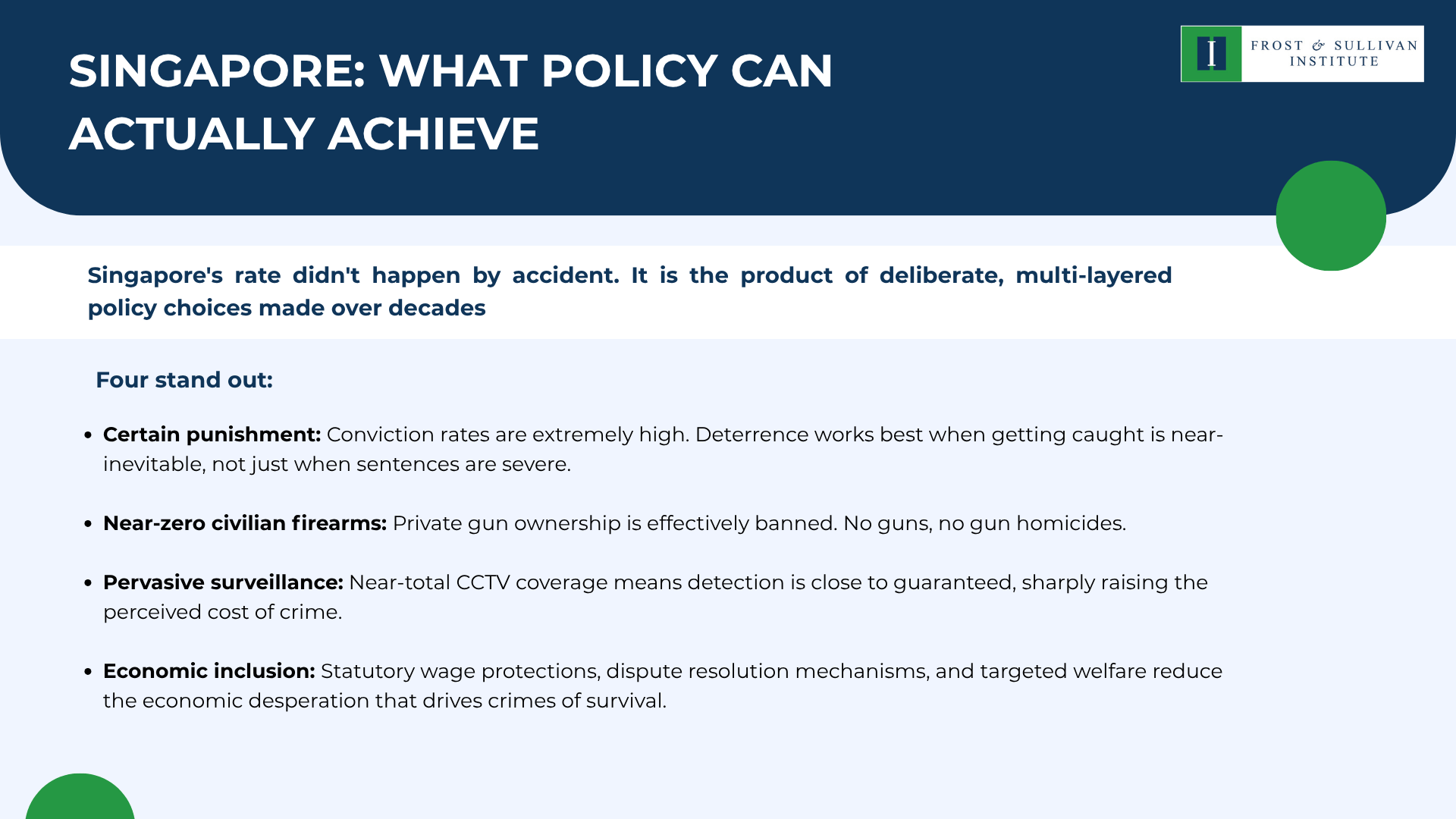
The result is a society where the probability of being caught is high, the means for lethal violence are unavailable, and the economic pressure to resort to crime is structurally managed, a combination the US has not achieved in any of its dimensions.
Conclusion
The UNODC projects that the global homicide rate will fall to 4.7 per 100,000 by 2030. That matters, but it also means the world will still be losing hundreds of thousands of people every year to a largely preventable cause. The US case shows that wealth alone does not produce safety. Singapore shows how far deliberate policy can travel. The 440,000 lives lost annually are not an inevitable toll, they are a measure of how much further the world has yet to go.
Blog by Samyuktha Purusothaman Nair, Research Analyst, Frost & Sullivan Institute