
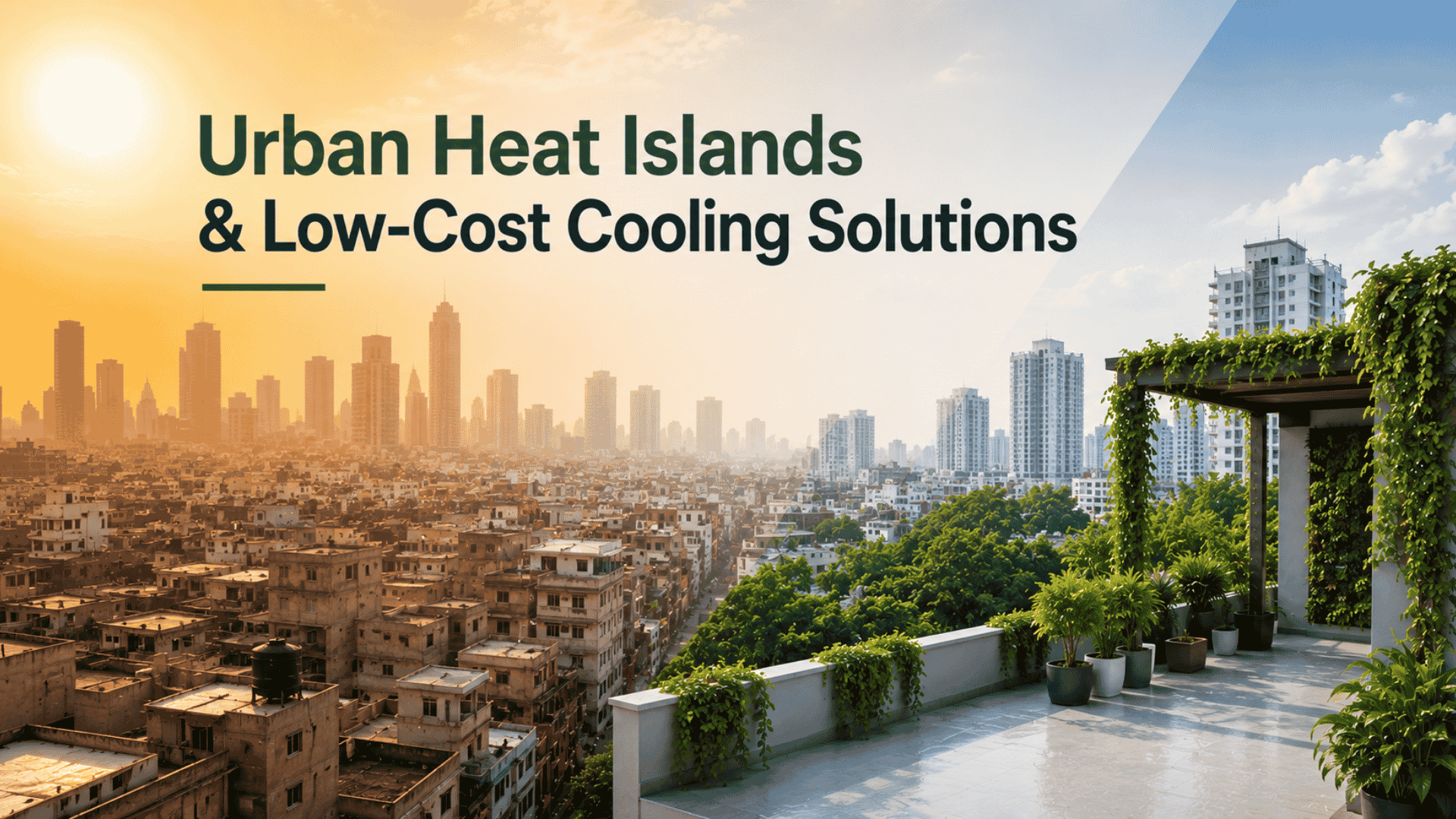
08 Jun Urban Heat Islands & Low-Cost Cooling Solutions
Heat is an important environmental and occupational health hazard and a leading cause of weather-related deaths that can exacerbate underlying illnesses, including cardiovascular disease, diabetes, mental health, asthma, and can increase the risk of accidents and transmission of some infectious diseases. Heatstroke is a medical emergency with a high-case fatality rate. According to the WHO, between 2000 and 2019, studies show approximately 489 000 heat-related deaths occur each year, with 45% of these in Asia and 36% in Europe.
Heat islands trap heat in cities, hitting the poor hardest due to their dense, vegetation-poor neighborhoods with heat-absorbing roofs. Urban heat islands (UHIs) exacerbate extreme heat, disproportionately burdening low-income communities due to their location in heat-trapping dense areas with minimal green cover and poor housing materials like metal or asbestos roofs. Low-cost design interventions such as cool roofs, urban trees, and restored water bodies can significantly mitigate this by reflecting heat, providing shade, and enabling evaporative cooling.
Heat's Toll on the Poor
Low-income areas endure stronger UHIs from asphalt, concrete, and scant greenery, worsening heat stress. In US cities, low-income and minority groups face disproportionate exposure, with 72% of global cities showing higher heat in poorer zones. Extreme heat in Least Developed Countries (LDCs) is a rapidly intensifying crisis, with 2024 marking the hottest year in 175 years, and projections indicating that 2026 will likely be among the four hottest on record. Vulnerable housing amplifies risks like dehydration and power outages during peaks. Low-income neighborhoods often face higher UHI intensities because they feature cramped settlements with heat-absorbent materials and limited vegetation, amplifying exposure. Globally, the poor have higher heat vulnerability, compounded by factors like housing instability and lack of cooling access.
The disproportionate exposure of low-income communities to extreme heat shows the urgent need for structured, institutional responses capable of reducing vulnerability at scale. Against this backdrop, Ahmedabad’s pioneering Heat Action Plan offers a salient example of how city governments can translate scientific evidence and community vulnerabilities into a comprehensive, multi-sectoral framework for heat resilience.
Ahmedabad’s Heat Action Plan: A Case Study on Urban Cooling Interventions
Ahmedabad, a major industrial and urban center in western India, experiences extreme heat during the summer, with daily maximum temperatures frequently exceeding 46 °C. This severe heat has made public health preparedness a priority for city authorities, especially after the 2010 heat wave, which was associated with a large spike in mortality.
In response, the Ahmedabad Municipal Corporation (AMC), along with the Indian Meteorological Department (IMD), Indian Institute of Public Health, Gandhinagar, and non-government partners, launched India’s first city-level Heat Action Plan in 2013.
The HAP integrates heat-health early warning systems with public awareness campaigns, inter-agency coordination to prepare healthcare facilities, and targeted outreach to vulnerable populations, including workers outdoors and residents of low-income neighborhoods.
Scientific evaluations have found that Ahmedabad’s HAP was associated with reduced mortality: a peer-reviewed study estimated that an estimated ~2,380 deaths were avoided in the first two years after implementation (2014–2015) compared with a pre-HAP baseline (2007–2010). At the same time, heatstroke cases and heat-related hospitalizations dropped significantly in subsequent years.
- Urban heat mapping and vulnerability assessment have been part of the plan’s evolution. The HAP’s main risk-targeting tools involve heat-health datasets, demographic information on vulnerable groups, and outreach data rather than a specific Landsat-derived heat map per ward.
- Cool roof programs have been implemented under the HAP framework. These involve reflective roof coatings to reduce indoor heat gains, particularly in slum areas and municipal buildings. Studies and reports note several thousand cool roofs installed across slum households and public buildings, often estimated to reduce indoor temperatures by a few degrees.
- Water body restoration around areas like Sarkhej Roza offers benefits beyond heat adaptation (e.g., groundwater recharge and biodiversity), but its role in the official HAP strategy is more complementary than central. Formal HAP updates emphasize warnings, communication, healthcare readiness, and adaptive actions.
While Ahmedabad’s Heat Action Plan illustrates how a city can translate extreme heat risk into a coordinated, data-informed public health strategy, the challenges posed by urban heat islands extend far beyond South Asia. Cities worldwide are experimenting with diverse, context-specific interventions that blend policy innovation, ecological design, and material technology to mitigate rising temperatures and protect vulnerable populations. Examining these global examples offers a broader perspective on how different urban systems are operationalizing heat resilience.
Three Key Successes
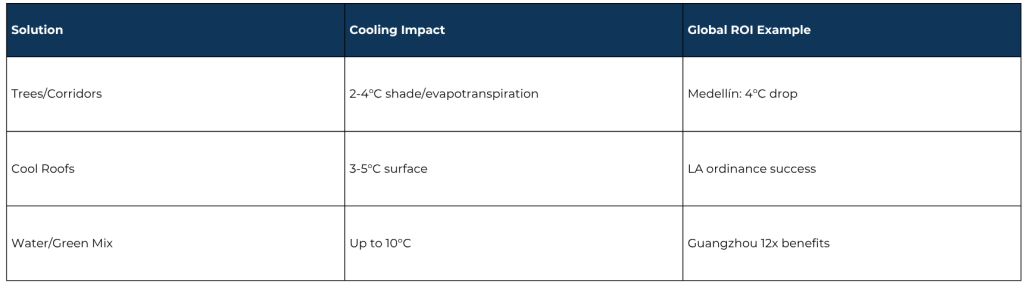
Guangzhou restored ventilation corridors and water bodies, yielding 12x cost benefits and 3-5°C indoor cooling. Los Angeles’ cool roofs ordinance slashed rooftop heat, informing scalable policies. Medellín’s 36 green corridors dropped surrounding temps by 4°C.
Global Examples
Guangzhou’s urban cooling initiatives exemplify the integration of nature-based solutions into large-scale climate adaptation planning. Supported by World Bank analyses, the city’s strategy combines wind corridors, restored water systems, and green roofs to enhance natural ventilation and evapotranspiration, yielding measured temperature reductions of 0.5–5°C across urban districts. These measures have been characterized as economically efficient, generating up to twelve times the value of the initial investment through reduced energy demand and enhanced ecosystem services. The program aligns with global best practices, emphasizing ecological design as a means to mitigate heat stress, reduce reliance on artificial cooling, and strengthen resilience to climatic extremes.
Medellín’s Green Corridors initiative represents a significant urban ecological transformation validated by global climate leadership organizations. The project introduced over 30 interconnected green corridors that link mountains, waterways, and densely populated districts, leading to citywide temperature reductions of approximately 2°C and localized cooling of up to 4.5°C through shading and evapotranspiration. These outcomes additionally highlight improvements in air quality, biodiversity recovery, and increased pedestrian comfort. The initiative demonstrates that low-cost, nature-based interventions can deliver rapid, measurable thermal benefits without requiring large-scale structural redevelopment.
Los Angeles’ formalized one of the earliest municipal mandates requiring cool roof technologies as part of new construction and major renovations, establishing minimum solar reflectance and thermal emittance standards to counteract the city’s intensifying urban heat island effect. Policy analyses note that cool roofs measurably reduce rooftop surface temperatures, thereby lowering cooling energy demand and contributing to broader ambient heat mitigation. Subsequent expansions of the policy into complementary surface and landscape measures like permeable pavements and urban tree planting underscore the ordinance’s foundational role in shaping LA’s integrated heat resilience strategy.
Conclusion
As heat extremes continue to intensify, cities that prioritize inclusive, science-driven, and adaptive strategies will be best positioned to safeguard public health and ensure that the benefits of climate resilience reach those most at risk. The escalating intensity of urban heat underscores an urgent global imperative that cities must transition from reactive responses to proactive, equity-centered resilience planning. Nature-based solutions, material innovations, and regulatory reforms each offer distinct but complementary avenues for mitigating the urban heat island effect. Effective heat resilience depends not only on technical solutions but also on commitment to environmental justice and long-term urban planning. As heat extremes continue to intensify, cities that prioritize inclusive, science-driven, and adaptive strategies will be best positioned to safeguard public health and ensure that the benefits of climate resilience reach those most at risk.
Blog by Shreya Ghimire,
Research Analyst, Frost & Sullivan Institute