India’s economy has started FY2026-27 on a strong footing, with real GDP growing 7.8% in Q1 and real exports of goods and services rising 12%. But sustaining this momentum requires more than increasing exports; it requires strengthening the domestic supply chains that support them.
Several industries continue to rely on imported raw materials and intermediate inputs, limiting the value created within India. Reducing this dependence does not mean eliminating imports but building competitive domestic alternatives that can strengthen production while addressing wider challenges such as agricultural waste, plastic pollution and resource inefficiency.
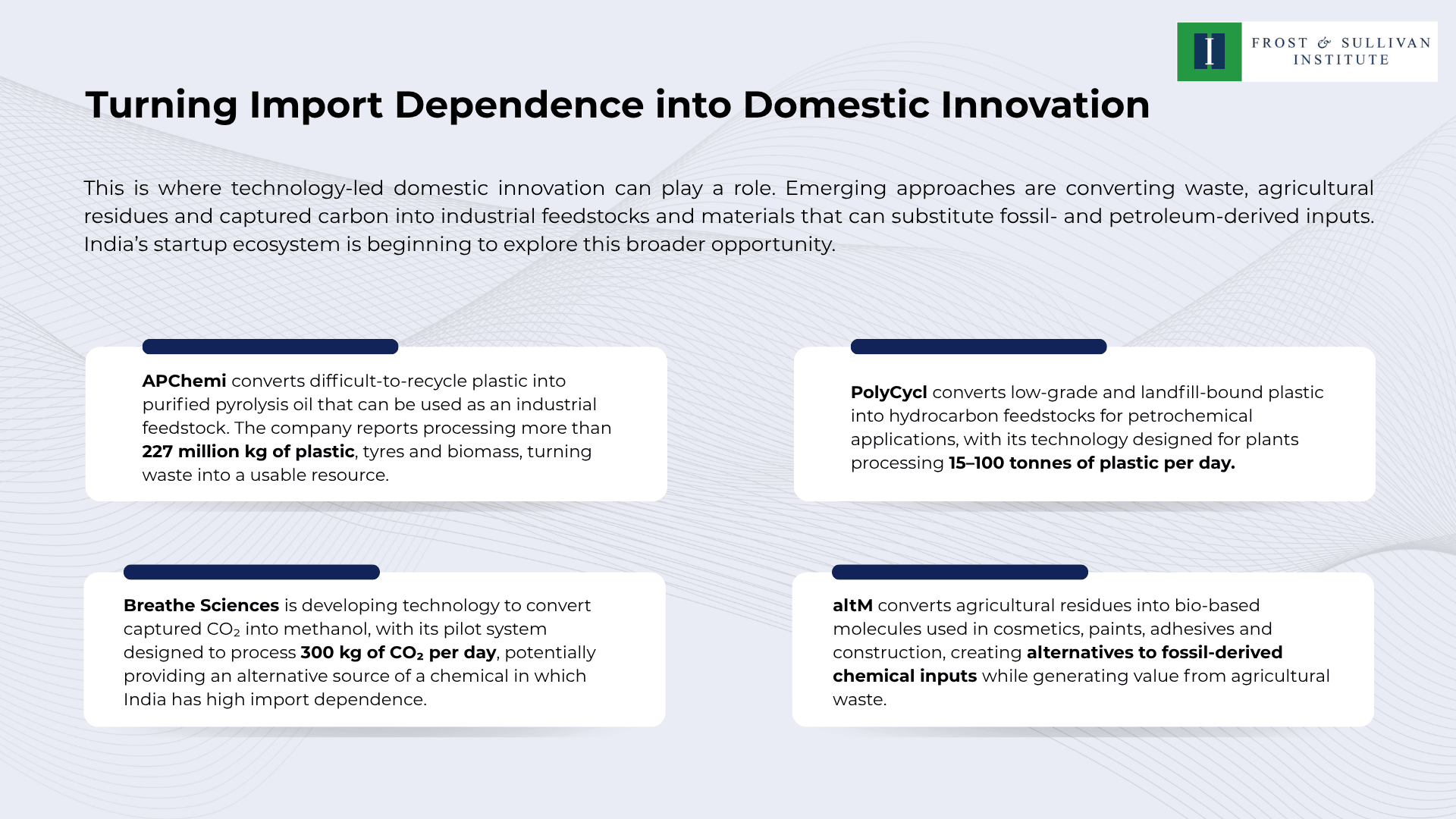
This is where domestic innovation can make a difference. Emerging Indian startups are developing alternatives to imported industrial inputs by turning waste, agricultural residues and captured carbon into valuable resources. Their innovations demonstrate how strengthening domestic supply chains can go hand in hand with tackling environmental challenges and creating wider economic value.
This blog looks beyond India’s 12% export growth to examine foreign input dependence and how domestic innovation could help build more resilient and sustainable supply chains.
India’s Export Growth
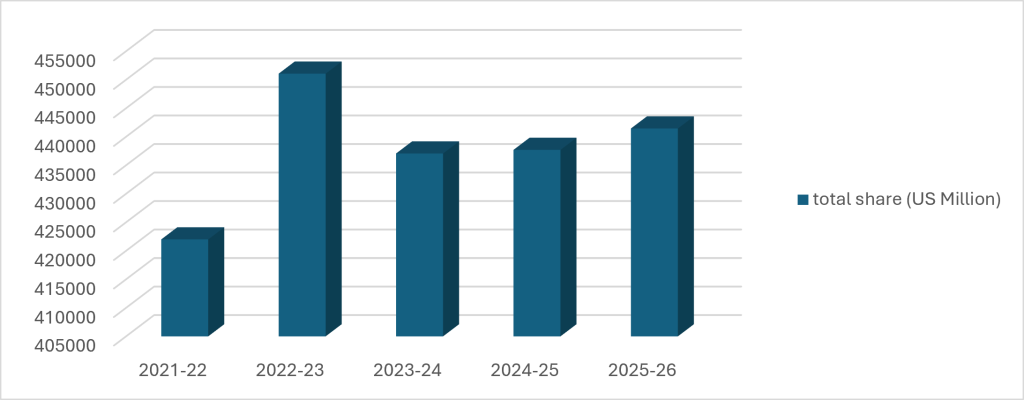
India’s export base has remained substantial, with merchandise exports increasing from around USD 422 billion in FY2021-22 to about USD 441.5 billion in FY2025-26. Although growth has not been linear, the overall export base remains significantly higher than it was five years ago. This expansion reflects India’s increasing participation in global markets and creates opportunities for domestic manufacturers, suppliers and service providers to connect with international demand.
Fig 1: India’s Merchandise Exports, FY2021-22 to FY2025-26
But export value alone does not tell us how much economic value is actually being created within the country. The next question is: how much of India’s exports depends on value generated abroad?
The Foreign Value-Added Question
According to the OECD’s latest Trade in Value Added estimates, the foreign value-added content of India’s gross exports increased from 21.9% in 2010 to 25.7% in 2022. In simple terms, a larger share of the value embodied in India’s exports originated from foreign inputs. The 2022 figure was also above the G20 average of 19.8%.
The trend is not necessarily a sign that India is becoming excessively dependent on imports. Participation in global value chains requires countries to source inputs from wherever they are most competitive. Imported components can improve productivity, product quality and export competitiveness. The issue is whether domestic capabilities are expanding alongside this integration.
Turning Import Dependence into Domestic Innovation
The foreign value-added content of India’s exports varies considerably across industries. According to the OECD TiVA database, in 2022, coke and refined petroleum products recorded 62.94% foreign value-added content, followed by chemicals and non-metallic mineral products at 52.41% and chemicals and chemical products at 47.07%. Pharmaceuticals, ICT and electronics, and basic metals also recorded foreign value-added shares of around 40% or more. This indicates that a substantial share of the value embedded in some Indian exports still originates from imported inputs, highlighting gaps in upstream domestic capabilities.
The dependence extends to several critical chemical inputs. NITI Aayog reports that methanol and acetic acid had import dependencies of 85-90% in FY2025, while phenol stood at around 41%. It also notes that domestic acetic acid production can itself depend on imported methanol, creating an additional layer of indirect import dependence. The opportunity, therefore, is not to eliminate imports, but to develop competitive domestic alternatives where they can strengthen supply security and retain more value within India.
The Takeaway for India
While these startups have not yet established a measurable reduction in India’s overall import dependence, they point to a promising direction. Closer alignment between government policy and private investment can help such technologies move from early-stage solutions to scalable domestic industries, reducing reliance on imported inputs while also tackling waste, emissions and resource inefficiency. This would give India’s recent 12% export growth a stronger foundation. If these innovations are scaled alongside supportive policies, India could not only sustain its export momentum but potentially deliver even stronger growth in the quarters ahead, truly turning import dependence into domestic innovation.
Blog by Samyuktha Purusothaman Nair, Research Analyst, Frost & Sullivan Institute