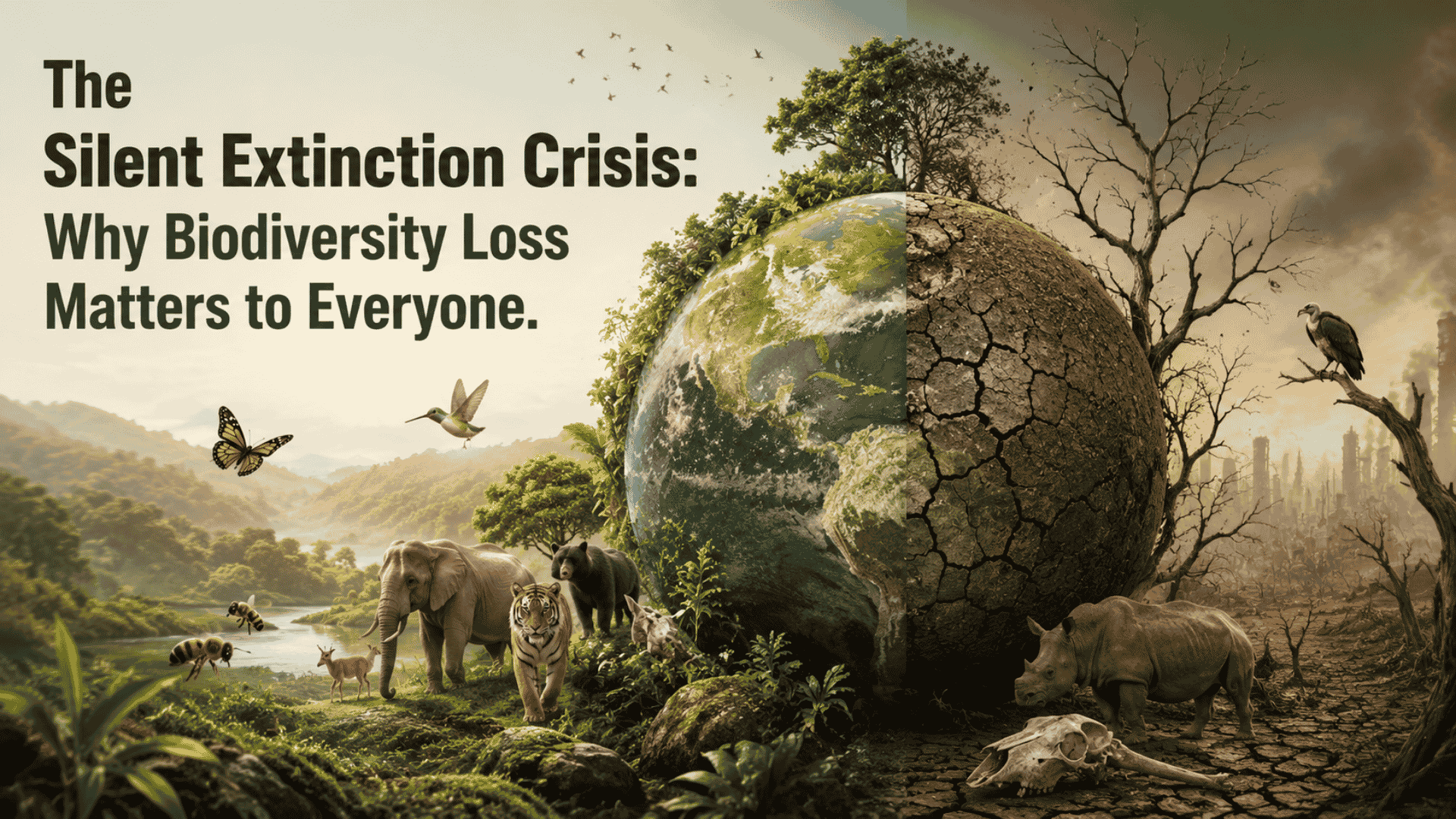
24 Aug The Silent Extinction Crisis: Why Biodiversity Loss Matters to Everyone
Biodiversity loss is often described as a “silent crisis” because, unlike climate disasters or pandemics, its progression is gradual and less immediately visible. Yet the erosion of life on Earth is occurring at an unprecedented pace and scale. Far from being a niche environmental issue, biodiversity loss represents a systemic risk to human well-being and has profound implications for wildlife and for global economies, food systems, public health, and climate stability.
What Is Biodiversity and Why Should We Care?
Biodiversity refers to the variety of life across three interconnected levels: genetic diversity within species, species diversity within ecosystems, and ecosystem diversity across landscapes and seascapes. This complexity underpins ecosystem functioning. Healthy ecosystems regulate climate, cycle nutrients, purify water, pollinate crops, and protect coastlines from storms.
A Global assessment published in Nature estimated the annual value of ecosystem services at between $125 trillion and $140 trillion, exceeding global gross domestic product. Biodiversity, therefore, functions as a form of natural capital that underpins the global economy.
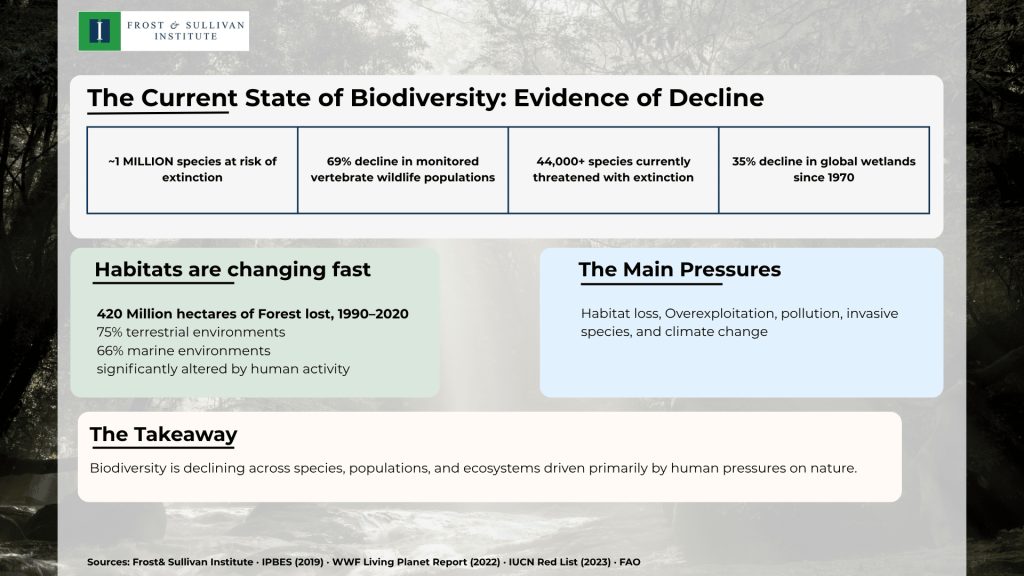
Importantly, current extinction rates are estimated to be tens to hundreds of times higher than the natural background rate. Such acceleration signals systemic ecological destabilization rather than isolated species loss.
How Biodiversity Loss Affects Humanity
The degradation of biodiversity has direct and cascading impacts on human societies.
- Food Security
Approximately 75% of global food crops depend, at least in part, on animal pollination. Declines in pollinator populations threaten yields of fruits, vegetables, nuts, and oilseeds, with implications for nutrition and economic stability. Marine biodiversity is equally critical: fisheries provide protein for more than three billion people, yet over one-third of global fish stocks are overexploited.
Genetic diversity within crops and livestock enhances resilience to pests, diseases, and climatic variability. Homogenized agricultural systems reduce adaptive capacity and increase vulnerability to shocks.
- Public Health
Biodiversity plays a significant role in medicine. Roughly half of modern pharmaceuticals are derived directly or indirectly from natural compounds. Each species lost potentially represents the disappearance of unique biochemical properties that could contribute to future treatments.
Ecosystem disruption also increases zoonotic disease risk. Deforestation and wildlife trade intensify contact between humans and wildlife reservoirs of pathogens. Several major outbreaks, including Ebola and COVID-19, have been linked to ecological disturbance and human wildlife interfaces.
- Climate Regulation and Disaster Risk
Forests, peatlands, mangroves, and oceans function as major carbon sinks. Tropical forests alone absorb approximately 7.6 billion metric tons of CO₂ annually. Biodiverse ecosystems are generally more stable and resilient, enabling them to withstand climate extremes and recover from disturbances more effectively.
Conversely, degraded ecosystems lose their carbon storage capacity, accelerating climate change. The biodiversity and climate crises are therefore mutually reinforcing.
- Economic Stability
Nature-dependent sectors, including agriculture, fisheries, forestry, and tourism, support hundreds of millions of livelihoods. Coral reef ecosystems, for instance, provide coastal protection, fisheries resources, and tourism revenue valued at up to $375 billion annually. Their degradation exposes coastal communities to increased storm damage and economic loss. World Economic Forum report shows that $44 trillion of economic value generation is moderately or highly dependent on nature and its services.
Progress in Biodiversity Protection
Despite alarming trends, conservation interventions demonstrate that biodiversity loss is not irreversible.
Protected areas have expanded significantly in recent decades. As of 2023, approximately 17% of terrestrial areas and 8% of marine areas are under some form of protection. The Kunming-Montreal Global Biodiversity Framework, adopted in 2022, commits nations to protecting 30% of land and sea by 2030, the “30×30” target.
Targeted conservation programs have facilitated species recoveries. For example, the greater one-horned rhino populations declined steeply in the past due to a combination of hunting and habitat loss. Despite once reaching lows of just 200 individuals, conservation efforts like population management and tracking have helped this species make a comeback. While the greater one-horned rhino population is increasing, with around 2,100 to 2,200 mature individuals living today, more work is needed to protect them moving forward.
However, a substantial financing gap persists. Estimates suggest that $598–824 billion per year is needed to halt and reverse biodiversity loss, far exceeding current funding levels. Closing this gap requires redirecting environmentally harmful subsidies, estimated at around $500 billion annually, toward sustainable alternatives.
Pathways Forward: Protecting Biodiversity
Addressing biodiversity loss requires systemic transformation across governance, economic systems, and societal behavior.
- Sustainable land and sea management are foundational. Agricultural transitions toward regenerative and diversified practices can reduce habitat destruction while maintaining productivity. Sustainable fisheries management and expanded marine protected areas are critical for ocean recovery.
- Economic systems must incorporate natural capital accounting, ensuring that environmental externalities are reflected in financial decision-making. Aligning market incentives with ecological sustainability is essential to reversing degradation.
- Climate mitigation and biodiversity conservation should be pursued synergistically. Nature-based solutions, including forest restoration and mangrove conservation, could deliver up to 30% of the climate mitigation needed by 2030 while enhancing biodiversity outcomes.
- Indigenous peoples and local communities play a crucial role. They manage or hold tenure rights over lands containing approximately 80% of global biodiversity. Empirical evidence suggests that biodiversity outcomes in Indigenous-managed territories are often equal to or better than those in state-designated protected areas.
- Finally, individual choices reducing food waste, supporting sustainable supply chains, and advocating for science-based policies contribute to broader systemic change.
Conclusion: From Silent Crisis to Collective Action
Biodiversity loss is not an isolated environmental issue; it is a multidimensional challenge affecting food security, health, climate stability, and economic resilience. The scientific evidence is unequivocal: wildlife populations are declining, ecosystems are degrading, and extinction risks are accelerating. Yet conservation successes demonstrate that recovery is achievable when policies are evidence-based and adequately funded.
The increasing silent extinction crisis demands visibility, urgency, and coordinated action. Biodiversity conservation is not merely about protecting wildlife for its intrinsic value, though that value is considerable; it is about safeguarding the ecological foundations of human civilization. The coming decade will be decisive in determining whether humanity continues a trajectory of ecological decline or transitions toward a more sustainable and resilient coexistence with the natural world.
Blog by Shreya Ghimire,
Senior Research Analyst, Frost & Sullivan Institute