

11 Sep Empowering the Grassroots: SHGs and Cooperative Models as Engines of Financial Inclusion
Financial inclusion remains one of the most significant development challenges in emerging economies. According to the World Bank Global Findex Database (2021), about 1.4 billion adults worldwide still lack access to formal financial services, including bank accounts, credit, and insurance. A large share of this population lives in rural or low-income communities where traditional banking models struggle to operate due to high transaction costs, lack of collateral, and limited financial literacy.
In this context, Self Help Groups (SHGs) and cooperative financial models have emerged as powerful grassroots mechanisms for expanding access to finance. These community-based structures allow marginalized populations to participate in formal financial systems through collective savings, peer lending, and cooperative ownership. Rather than treating financial inclusion as charity, these models create locally owned financial ecosystems that support entrepreneurship, resilience, and long-term economic mobility.
Their effectiveness lies in their ability to overcome one of the biggest barriers in traditional banking, which is asymmetric information between lenders and borrowers. In conventional financial systems, banks often hesitate to lend to low-income individuals because they lack reliable credit histories or collateral. SHGs and cooperatives address this challenge through social accountability. Members know each other personally and share a stake in the group’s financial health. This form of social collateral often replaces the need for physical assets.
As digital monitoring tools and financial platforms have expanded in recent years, many governments and development institutions have also begun integrating digital record-keeping, mobile banking, and data-driven monitoring systems into SHG networks. These innovations strengthen transparency while preserving the community-driven nature of these institutions.
The Architecture of Grassroots Finance
At their core, SHGs and cooperative institutions rely on collective participation, shared accountability, and community-level governance. These models create financial structures that are both locally responsive and scalable.
Self Help Groups (SHGs)
Self Help Groups are small voluntary associations that typically consist of 10 to 20 members from similar socio economic backgrounds. Most SHGs are composed primarily of women, particularly in South Asia and parts of Africa.
Members contribute small savings on a regular basis, which are pooled into a group fund. This fund is then used to provide small loans to members for purposes such as starting microenterprises, managing household emergencies, or financing education.
Several features explain the effectiveness of SHGs:
- Affordability: Administrative costs remain low because the groups operate locally and require minimal infrastructure.
- Scalability: Many SHGs join larger federations that connect them to formal banking systems. In India, the SHG Bank Linkage Programme initiated by the National Bank for Agriculture and Rural Development (NABARD) has connected millions of SHGs with commercial banks.
- Women’s economic empowerment: Evidence shows that women-led SHGs have particularly strong development outcomes. According to the International Fund for Agricultural Development (IFAD), participation in SHGs significantly improves women’s decision-making power, household savings, and investment in children’s health and education.
Cooperative Financial Models
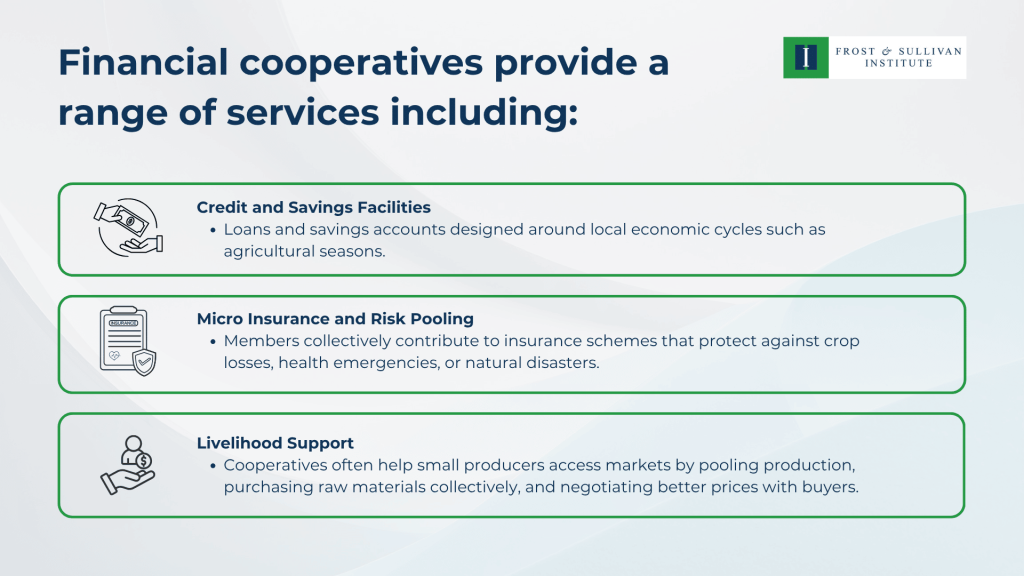
Cooperatives represent a more formal institutional structure. They are member owned organizations governed by democratic decision making, where each member typically has one vote regardless of capital contribution. Globally, the cooperative sector is significant. According to the International Cooperative Alliance, there are more than three million cooperatives worldwide serving over one billion members.
Why These Models Work
From an economic perspective, SHGs and cooperatives address two major market failures that often prevent financial inclusion.
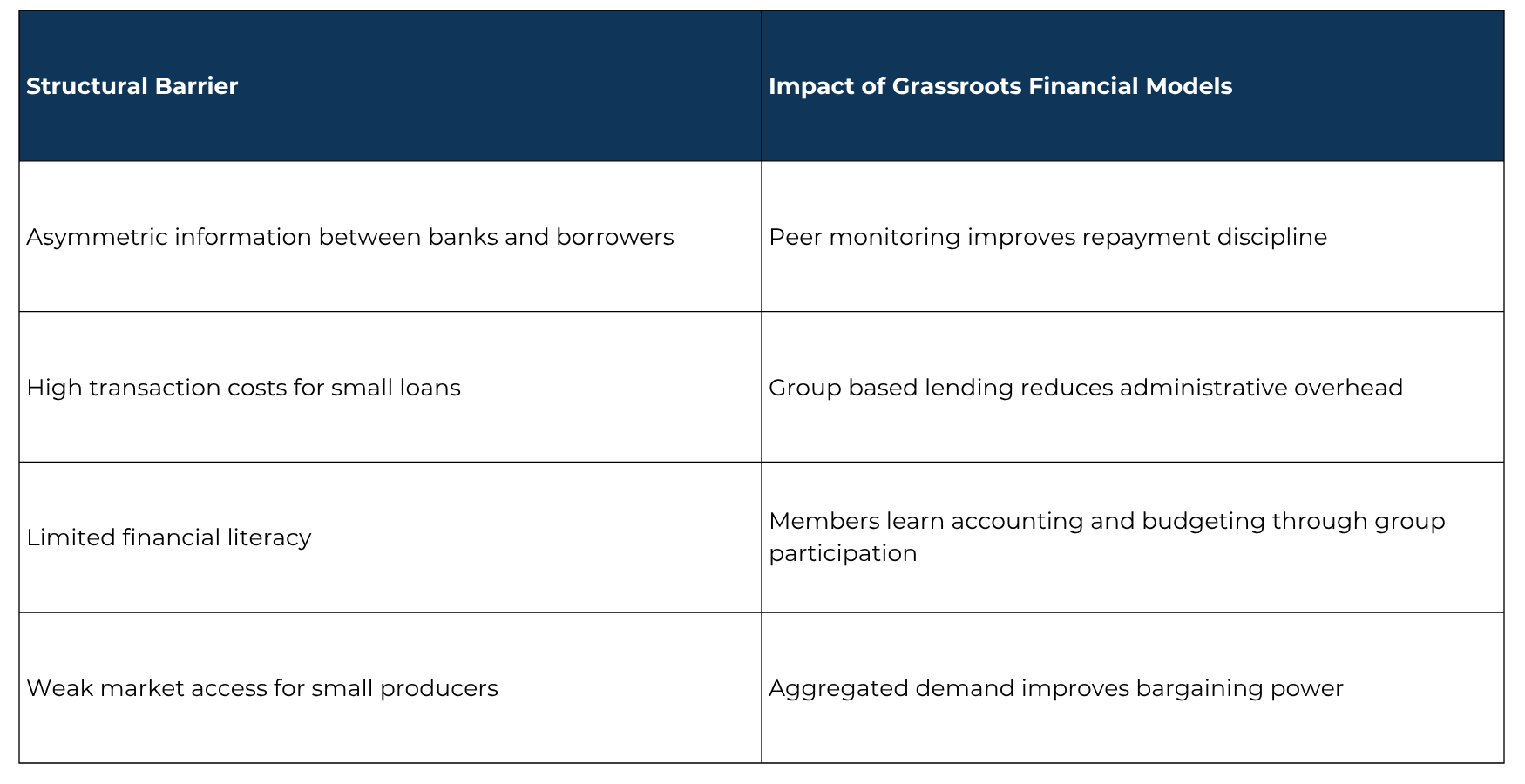
These mechanisms help explain why microfinance institutions and SHG based lending programs consistently demonstrate high repayment rates compared with many conventional credit markets.
One of the most widely studied examples of SHG based financial inclusion is Kudumbashree, the poverty eradication and women’s empowerment program launched by the Government of Kerala in India in 1998. Over the past two decades, Kudumbashree has evolved into one of the largest women led community development networks in the world. As of 2026, the program includes more than 4.8 million women organized into over 317,000 neighborhood groups. The institutional design of Kudumbashree follows a three-tier structure that combines local autonomy with administrative scale.
Neighborhood Groups serve as the primary units where members save, lend, and meet regularly. These groups are federated into Area Development Societies, which coordinate activities at the ward level. At the top of the structure are Community Development Societies, which operate at the local government level and connect grassroots institutions with state-level development programs. The model has demonstrated strong financial discipline. Within India’s National Rural Livelihood Mission, the SHG Bank Linkage Programme has maintained non-performing asset levels of around 2 percent, significantly lower than many segments of commercial lending. According to NABARD reports, repayment rates often exceed 95 percent, which reflects the strength of peer accountability within the SHG system.
Beyond financial outcomes, Kudumbashree has also generated broader economic impacts. The network supports thousands of microenterprises in sectors such as food processing, agriculture, waste management, and local manufacturing, creating employment opportunities for women who previously had limited access to formal labor markets.
The Future of Community-Based Finance
The next phase of financial inclusion will likely combine community-driven institutions with digital financial infrastructure. Mobile banking platforms, digital identity systems, and interoperable payment networks are increasingly being integrated with SHG and cooperative ecosystems.
For example, India’s Jan Dhan financial inclusion program and digital payment platforms such as UPI have significantly expanded access to banking services among low-income households. When these digital tools are linked with grassroots financial groups, they can improve transparency, reduce fraud, and enable members to build formal credit histories. Development economists increasingly recognize that financial inclusion cannot rely solely on top-down banking expansion. Community institutions remain critical because they build trust, financial literacy, and collective resilience.
In an era of economic uncertainty, climate risk, and widening inequality, SHGs and cooperatives demonstrate that sustainable development often begins at the community level. By combining local knowledge with institutional support, these grassroots financial models are not simply filling gaps in the financial system. They are helping to reshape it.
Blog by Shreya Ghimire,
Senior Research Analyst, Frost & Sullivan Institute