05 Aug Breaking Barriers, Building Industries: The Women Driving Inclusive Economic Growth
For decades, the conversation around women’s empowerment has largely focused on boardrooms, leadership roles, and equal pay. Yet, some of the most transformative stories of inclusion are unfolding far from office spaces, in mines, construction sites, welding workshops, and trucking fleets. These are industries that have long been considered “men’s work,” not just because of the physical demands involved, but because of deeply rooted social and structural barriers.
While technological advancements have transformed the nature of industrial work, women’s participation in these sectors remains disproportionately low. The challenge today is no longer about capability; it is about access. Organizations across the world are proving that by investing in skills, mentorship, and inclusive workplaces, women can thrive in industries once considered out of reach.
A Three-Decade Gap That Refuses to Close
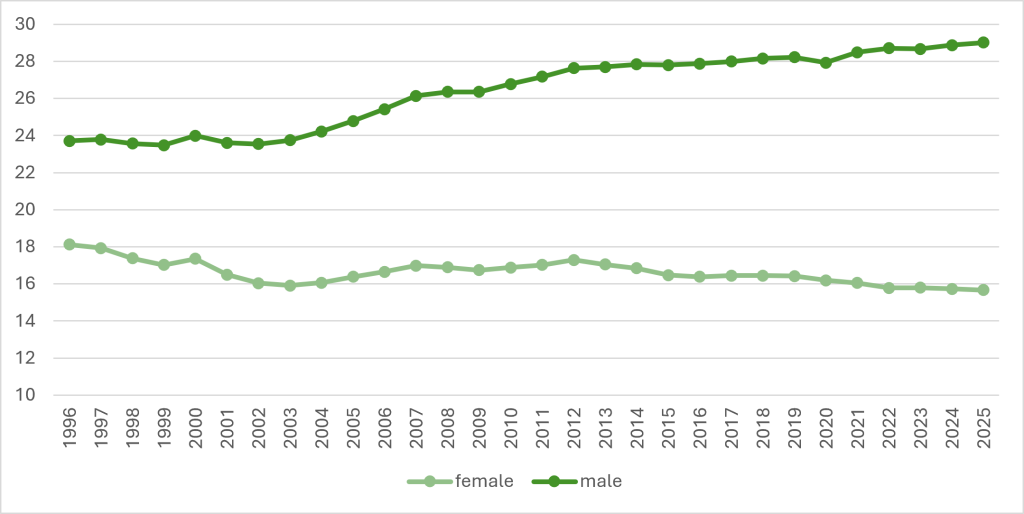
Fig 1: Global Employment in Industry by Gender (1996–2025)
Source: The World Bank Data
The trend analysis paints a clear picture. Between 1996 and 2025, the share of employed men working in industry steadily increased from around 23% to nearly 29%, while women’s participation declined from approximately 18% to around 15–16%. Rather than narrowing, the gender gap in industrial employment has widened over the last three decades.
The Changemakers Redesigning Heavy Industries
Around the world, a growing number of not-for-profit organizations are moving beyond advocacy to create practical pathways into industrial careers. Their work demonstrates that meaningful inclusion begins with removing barriers, building skills, and creating environments where talent, not gender, determines opportunity.
Mining has historically been one of the world’s most male-dominated industries. Women in Mining Zimbabwe, founded by Dr. Faith Mutota, is changing that by supporting women across the entire mining value chain, from prospecting and mineral extraction to processing, value addition, and trade. The organization has trained and supported more than 600 women artisanal and small-scale miners, helping them access technical knowledge, entrepreneurship opportunities, and safer mining practices. Its approach transforms mining from an exclusionary sector into a pathway for economic empowerment.
In Canada, Women Building Futures (WBF), established in 1998 by a collective of social workers and community leaders, addresses both the underrepresentation of women in skilled trades and growing labour shortages. Through hands-on training, career coaching, and employer partnerships, the organization prepares women for careers as heavy equipment operators, electricians, welders, pipefitters, and industrial maintenance technicians. Over the past 25 years, nearly 3,000 women have graduated from its industry-focused training programs. In 2023–24 alone, WBF trained a record 284 graduates, and 80% secured employment within six months, earning wages above the local living wage. By connecting graduates directly with employers, it demonstrates that workforce inclusion can strengthen both businesses and communities.
Tatu Gatere, co-founder of BuildHER, is transforming construction by preparing women from low-income communities for skilled careers in masonry, carpentry, painting, tiling, cabinetry, and solar installation. Since its inception, the organization has trained over 1,200 women and placed more than 1,050 into construction jobs. Graduates earn 4.5 times more income than their baseline earnings, while over 80% remain employed in the construction sector, demonstrating strong long-term retention in an industry where women have historically been excluded. BuildHER also works with employers to create safer, more inclusive construction sites, driving systemic change alongside workforce development.
Welding remains one of manufacturing’s most specialized and physically demanding professions. Women Who Weld, founded by Samantha Farrugia, is opening doors to one of manufacturing’s most specialized trades. Through hands-on welding training, apprenticeships, and employer partnerships, the organization equips women with industry-recognized skills that lead to stable, high-demand careers in fabrication and manufacturing, while helping diversify the skilled trades workforce.
The logistics sector is the backbone of global supply chains, yet trucking has long remained heavily male-dominated. Ellen Voie’s Women In Trucking Association works to recruit, retain, and advance women as professional drivers and industry leaders through mentorship, advocacy, leadership development, and partnerships with employers. As the global logistics industry faces persistent driver shortages, the association demonstrates how greater gender diversity can strengthen supply chain resilience while creating new economic opportunities.
Rebuilding Industries, Not Just Breaking Barriers
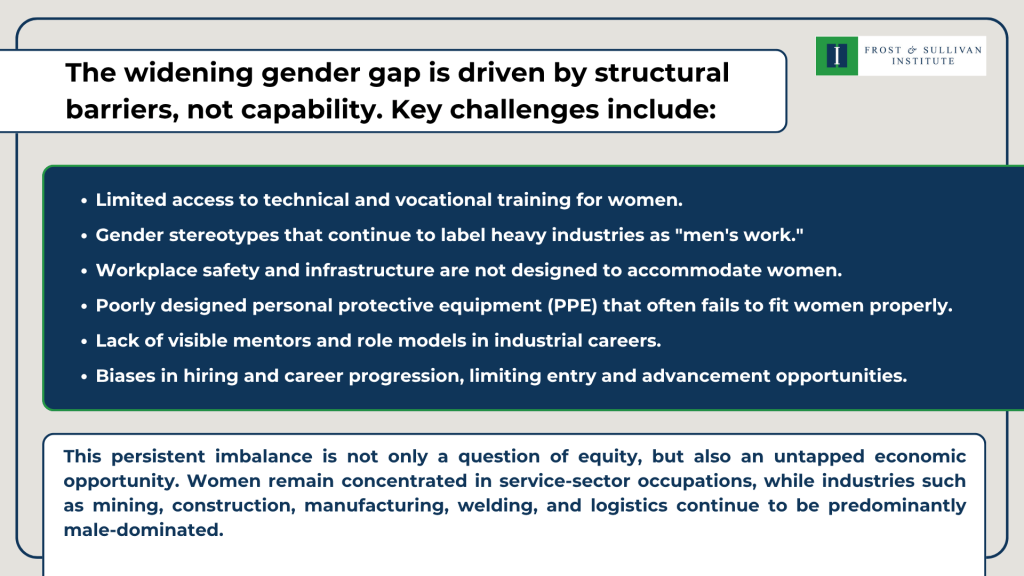
The data complicates a comforting myth: that the only barrier standing between women and these industries was ever brute strength. Mechanization, better protective equipment, and shifting job design have already narrowed that gap. What’s slowing progress is structural, childcare access, safety infrastructure designed for one body type, biased hiring pipelines, and a lack of visible mentors.
So the story isn’t simply that women are proving they can do “men’s jobs.” It’s that organizations like these are quietly redesigning who these industries were ever built for in the first place, one welding class, one mining cooperative, one trucking cohort at a time. The toughest industries aren’t just being entered by women anymore. They’re being rebuilt by them.
Blog by Samyuktha Purusothaman Nair,
Research Analyst, Frost & Sullivan Institute