
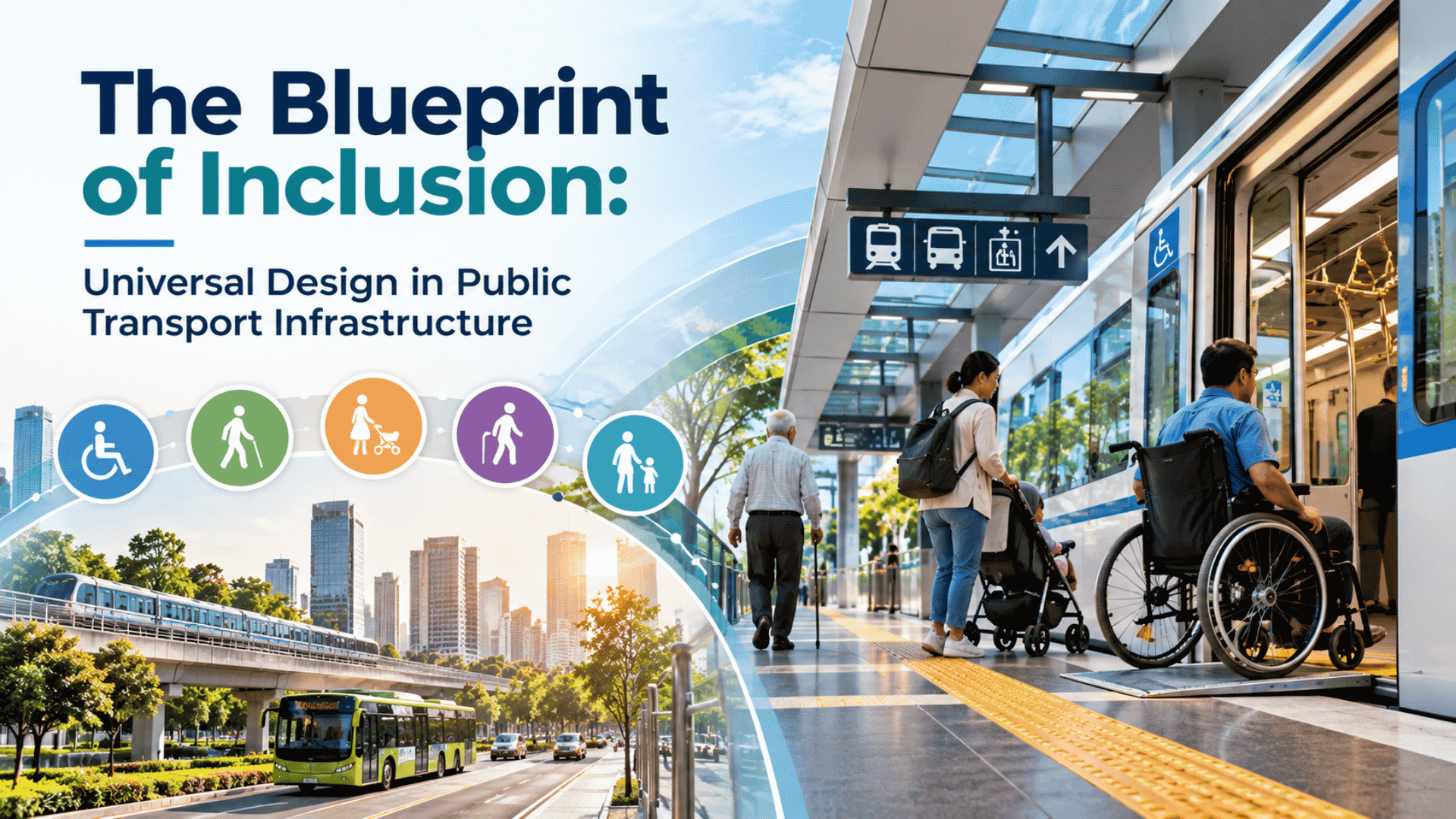
30 Oct The Blueprint of Inclusion: Universal Design in Public Transport Infrastructure
In contemporary urban planning discourse, public transport is often described as the circulatory system of a city, moving people, labor, and opportunity through urban space. Yet for a significant portion of the global population, this system remains inaccessible due to structural and design barriers. For people with disabilities, the elderly, caregivers with strollers, and individuals with temporary mobility limitations, public transport can become an exclusionary system rather than a public good.
To address this challenge, Universal Design (UD) has emerged as a critical framework in infrastructure planning. Universal Design refers to the creation of products and environments that are usable by all people, to the greatest extent possible, without the need for adaptation or specialized design. What once existed as a niche architectural concept is now increasingly understood as a core requirement of equitable urban development.
As of 2026, global policy frameworks such as the United Nations Convention on the Rights of Persons with Disabilities (CRPD) and Sustainable Development Goal 11 (Sustainable Cities and Communities) mandate that urban infrastructure must not only be functional but inherently inclusive. According to the World Health Organization, over 1.3 billion people, which is approximately 16% of the global population, live with some form of disability, while the share of people aged 60 and above is projected to reach 1.4 billion by 2030. These demographic realities mean that accessibility is not a marginal concern but a central planning imperative.
The Core Elements of Accessible Transport Infrastructure
True economic and social participation is impossible if individuals cannot physically access workplaces, educational institutions, healthcare facilities, and civic spaces. Universal Design in transport systems therefore focuses on creating a “Seamless Travel Chain,” ensuring that every stage of a journey, right from sidewalks and stations to vehicles and digital interfaces, is barrier-free.
Accessible Vehicles: Low-Floor Technology and Inclusive Boarding
The transition from high-entry buses with steep steps to low-floor buses (LFBs) represents one of the most significant advancements in inclusive transit design. These vehicles significantly reduce physical barriers for wheelchair users, elderly passengers, and travelers with limited mobility.
Modern accessible vehicles typically incorporate several key features. Pneumatic kneeling systems allow buses to lower the entry side toward the curb, reducing step height to less than 250 millimeters and easing boarding. Automated or manual fold-out ramps bridge the gap between the curb and the vehicle floor, enabling wheelchair users, parents with strollers, and travelers carrying luggage to board safely.
Another critical concept is level boarding, widely used in Bus Rapid Transit (BRT) and rail systems. By aligning station platforms with the vehicle floor, passengers can board horizontally rather than stepping up or down. Beyond improving accessibility, level boarding reduces dwell time at stations and increases operational efficiency.
Inclusive Stations: Wayfinding and Sensory Accessibility
While accessible vehicles are critical, accessibility must also extend to station infrastructure and passenger navigation systems. For visually impaired commuters and elderly passengers, multi-sensory navigation systems are essential.
One of the most widely adopted solutions is Tactile Ground Surface Indicators (TGSIs) raised studs or bars embedded in walking surfaces that guide visually impaired individuals toward safe pathways, entrances, and platform edges. Research in transport safety indicates that tactile paving can reduce the risk of platform-related falls by more than 80% among visually impaired passengers.
High-contrast signage is another essential feature. Urban design standards recommend a Light Reflectance Value (LRV) contrast of at least 70% between text and background to ensure readability for passengers with declining vision.
Acoustic wayfinding systems also play an important role in large multi-level transport hubs. Audio-enabled elevators, digital kiosks with speech output, and audible announcements allow passengers with visual impairments to navigate complex transport interchanges independently.
Impact Analysis: The “Curb-Cut Effect”
Urban planning literature frequently refers to the “Curb-Cut Effect,” which describes how design interventions initially intended for marginalized groups ultimately benefit the entire population. Curb ramps, originally introduced to improve mobility for wheelchair users, are now widely used by cyclists, travelers with rolling luggage, delivery workers, and parents with strollers. Similar benefits have been observed in public transport accessibility improvements. For example, a 2025 longitudinal study of the Curitiba Bus Rapid Transit system in Brazil found that the introduction of full level boarding and universal access features increased ridership among elderly passengers by 22%, while reducing average boarding time by 15% across the entire system. These findings highlight that inclusive infrastructure does not merely fulfill ethical obligations, it also enhances operational performance and user experience for all passengers. In this sense, universal design demonstrates that inclusion and efficiency are not competing priorities but mutually reinforcing outcomes.
Implementation Challenges in the Global South
Despite clear benefits, implementing universal design remains uneven globally. Cities in developing countries often face financial, institutional, and spatial constraints that limit large-scale accessibility upgrades.
Many public transport systems in the Global South rely heavily on informal transit networks, including minibuses, shared taxis, and motorcycle transport, which typically lack accessibility features. According to the World Bank, fewer than 30% of urban transport systems in low-income countries meet basic accessibility standards.
Retrofitting infrastructure can also be expensive. Elevators, platform adjustments, and digital navigation systems require sustained investment and maintenance. However, failing to address accessibility imposes its own economic costs by excluding large segments of the population from the labor market and urban services.
Inclusion as Urban Strategy
Universal design in public transport infrastructure should not be understood solely as a disability policy. Rather, it is a strategic investment in economic participation, demographic resilience, and social equity.
Accessible transit systems enable broader workforce participation, support aging populations, and improve urban mobility for families and caregivers. As cities expand and populations age, inclusive infrastructure will become increasingly central to sustainable urban development.
The blueprint for inclusive cities therefore lies not in retrofitting accessibility as an afterthought but embedding universal design at the earliest stages of planning. When transport systems are designed for the margins, they ultimately work better for everyone.
In the future of urban mobility, accessibility will no longer be a specialized feature but will be the baseline standard for equitable cities.
Blog by Shreya Ghimire,
Senior Research Analyst, Frost & Sullivan Institute
Frequently Asked Questions
Universal design in public transport involves planning and developing transport infrastructure, vehicles, and services that are accessible and usable by people with diverse abilities, ages, and mobility needs. It aims to create inclusive travel experiences by reducing physical, sensory, and communication barriers.
Universal design helps make public transport more accessible through features such as step-free access, ramps, elevators, tactile paving, accessible signage, audio announcements, and level boarding. These features support persons with disabilities, older adults, parents with strollers, and other passengers who may face mobility challenges.
An inclusive public transport system incorporates accessible stations, barrier-free boarding, clear visual and audio information, tactile guidance, safe pedestrian crossings, and facilities that accommodate different mobility needs. Effective planning also considers affordability, passenger safety, and convenient connections between transport services.
Cities can improve accessibility by auditing existing transport infrastructure, retrofitting stations with ramps and elevators, improving pedestrian crossings, introducing accessible passenger information systems, and consulting people with diverse mobility needs. Integrating universal design into new infrastructure projects can also help reduce the need for costly modifications later.
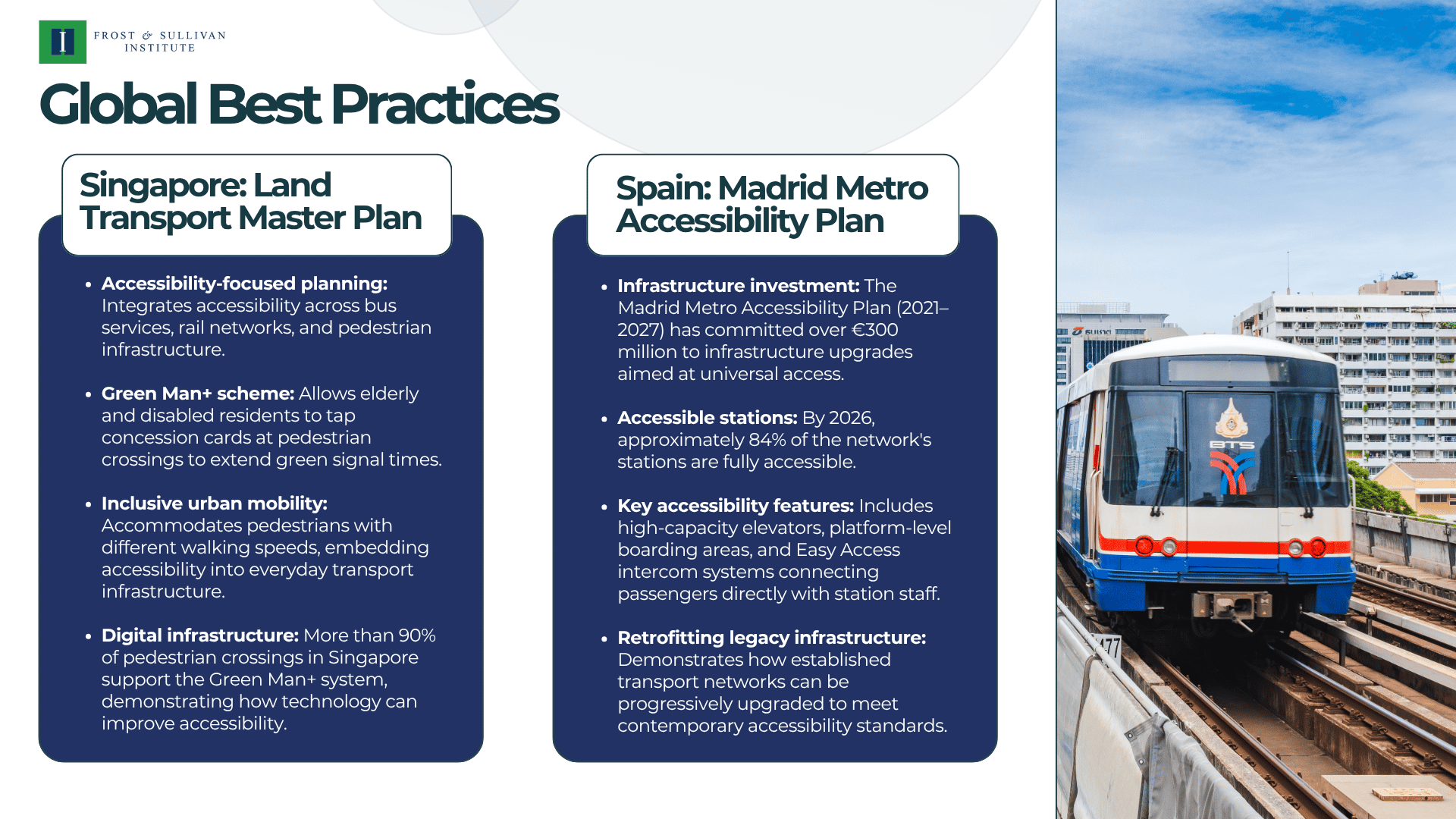
Global best practices include Singapore’s accessibility-focused transport planning and Green Man+ pedestrian crossing scheme, which can extend crossing time for eligible older adults and persons with disabilities. Madrid’s Metro Accessibility Plan demonstrates another approach through investment in elevators, accessible station facilities, and improvements to existing infrastructure.
There is no universally accepted global ranking of countries with the most accessible public transport. Singapore is a strong example of accessibility-focused transport planning, while Spain, Switzerland and Denmark perform well on broader measures of public transport quality. Accessibility depends on factors such as step-free access, wheelchair-friendly facilities, accessible passenger information, and the reliability of elevators and ramps.