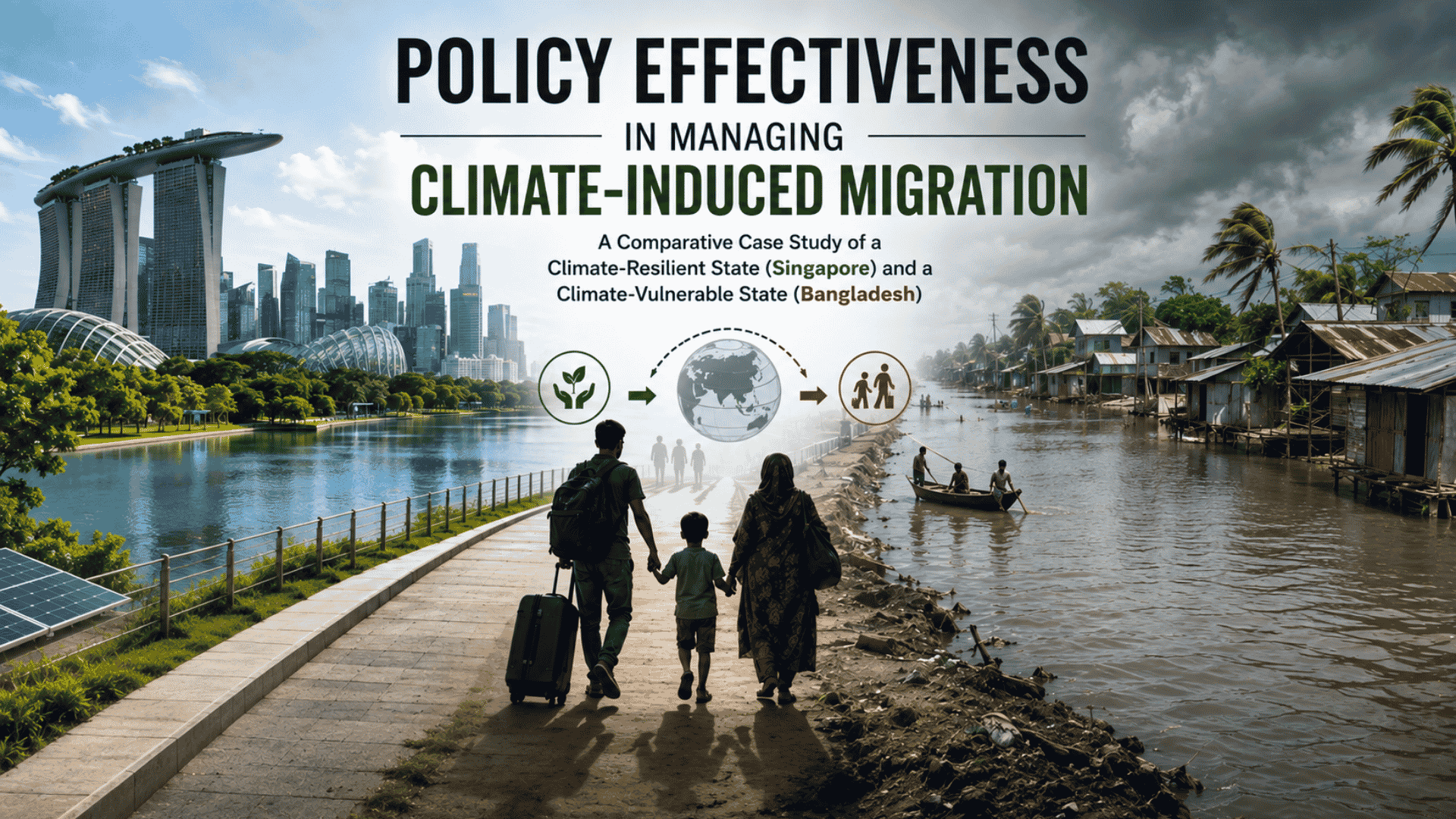
Policy Effectiveness in Managing Climate Induced Migration: A Comparative Case Study of a Climate-Resilient State (Singapore) and a Climate-Vulnerable State (Bangladesh)
12 Aug Policy Effectiveness in Managing Climate Induced Migration: A Comparative Case Study of a Climate-Resilient State (Singapore) and a Climate-Vulnerable State (Bangladesh)
Climate-induced migration has moved from the margins of environmental policy to the center of global mobility governance, yet the effectiveness of national responses to it remains poorly understood in comparative terms. This paper asks a focused question: why do two countries facing the same global climate trend arrive at such different migration outcomes? It compares Singapore, a small, high-income city-state consistently ranked among the world’s most climate-ready countries , with Bangladesh, a lower-middle-income delta nation that ranks among the most climate-exposed states on earth . Using a qualitative comparative case-study design supported by quantitative indicators like governance scores, adaptation financing, infrastructure outcomes, and displacement statistics, the study traces how each country’s institutions have shaped whether climate stress becomes a managed policy problem or an ongoing humanitarian one.
The comparison shows that Singapore has converted sustained governance capacity and early, large-scale infrastructure investment into the near-elimination of climate-related displacement as a policy issue, while Bangladesh has achieved remarkable success in reducing disaster mortality without achieving a comparable reduction in disaster displacement. That distinction between saving lives and preventing displacement is the paper’s central finding, and it reframes policy effectiveness as a multi-dimensional outcome rather than a single scorecard. The paper closes by arguing that closing this gap is not purely a matter of national governance reform: it is also a matter of global climate finance and responsibility-sharing, since the country bearing the greatest displacement burden contributes less than 0.5 percent of global greenhouse gas emissions .