
23 Nov The Design Deficit: Why is Women’s Safety a Structural Option, and Not a Universal Standard?
For decades, the standard for “human-centric” design has been anything but human. It has been male. In an era where we pride ourselves on precision engineering and data-driven solutions, the security and physical well-being of women is still treated as a “luxury upgrade” or a secondary consideration. This blog examines how the systematic exclusion of female data in three critical sectors, healthcare, automobiles, and digital technology has created a world where women are not just overlooked, but actively endangered.
The Automobile Industry: Designed for the "Standard" Male
The most literal example of women’s safety as a “mere option” is found in vehicle crash testing. Automobile is something that we use every day in our lives as a necessity for commute and yet this sector has highly ignored the safety of women. For over 50 years, the automotive industry has relied on crash test dummies based on the 50th-percentile male (approx. 1.75m tall and 78kg). While Women make up nearly 50% of drivers and car buyers globally. Until recently, the “female” dummies used in tests were simply scaled-down versions of male dummies, failing to account for female-specific bone density, muscle distribution, or spinal alignment. Due to this, data from 2024 and 2025 indicates that even when wearing a seatbelt, a woman is 73% more likely to be seriously injured and 17% more likely to die in a frontal crash than a man in the same position. The problem is that even now, manufacturers often place female dummies only in the passenger seat during tests, operating under the archaic assumption that the “primary user” (the driver) is male.
Healthcare: The "Male as Default" Biological Fallacy
In medicine, the male body is historically treated as the baseline, while the female body is viewed as a “complicated” variation due to hormonal cycles. The female body, bones, structure, hormones, everything is different from that of a man but yet females aren’t considered in healthcare as much as they should. Historically, women were excluded from clinical trials for decades. Even in 2025, only about 4% of research funding for cardiovascular disease, which is the leading killer of women, is directed toward female-specific studies. While women account for over 60% of pharmaceutical consumption and healthcare visits, hardly any studies is directed for the wellbeing of a woman. Due to this, women experience adverse drug reactions (ADRs) at nearly double the rate of men because dosages are often calculated based on male metabolic rates. A classic example is the sleep aid Zolpidem (Ambien); it took 20 years for the FDA to realize women metabolize it much slower, leading to a 50% reduction in the recommended dose for females after numerous accidents occurred.
Digital Technology and AI: Automating Bias
As we move into 2026, Artificial Intelligence (AI) has become the new frontier for gender exclusion. Because AI is trained on historical data (which is male-biased), it replicates and scales these biases at an industrial level. Only 26% of specialized AI roles and 12% of data science positions are held by women. A 2025 study found that facial recognition error rates for darker-skinned women are as high as 34%, compared to less than 1% for lighter-skinned men. The impact of this is that algorithms used in hiring, credit scoring, and healthcare diagnostics systematically penalize women. For instance, Apple Card’s algorithm famously gave women significantly lower credit limits than men with identical financial profiles because it viewed “female” variables as higher risk.
One of the most widely adopted solutions is Tactile Ground Surface Indicators (TGSIs) raised studs or bars embedded in walking surfaces that guide visually impaired individuals toward safe pathways, entrances, and platform edges. Research in transport safety indicates that tactile paving can reduce the risk of platform-related falls by more than 80% among visually impaired passengers.
High-contrast signage is another essential feature. Urban design standards recommend a Light Reflectance Value (LRV) contrast of at least 70% between text and background to ensure readability for passengers with declining vision.
Acoustic wayfinding systems also play an important role in large multi-level transport hubs. Audio-enabled elevators, digital kiosks with speech output, and audible announcements allow passengers with visual impairments to navigate complex transport interchanges independently.
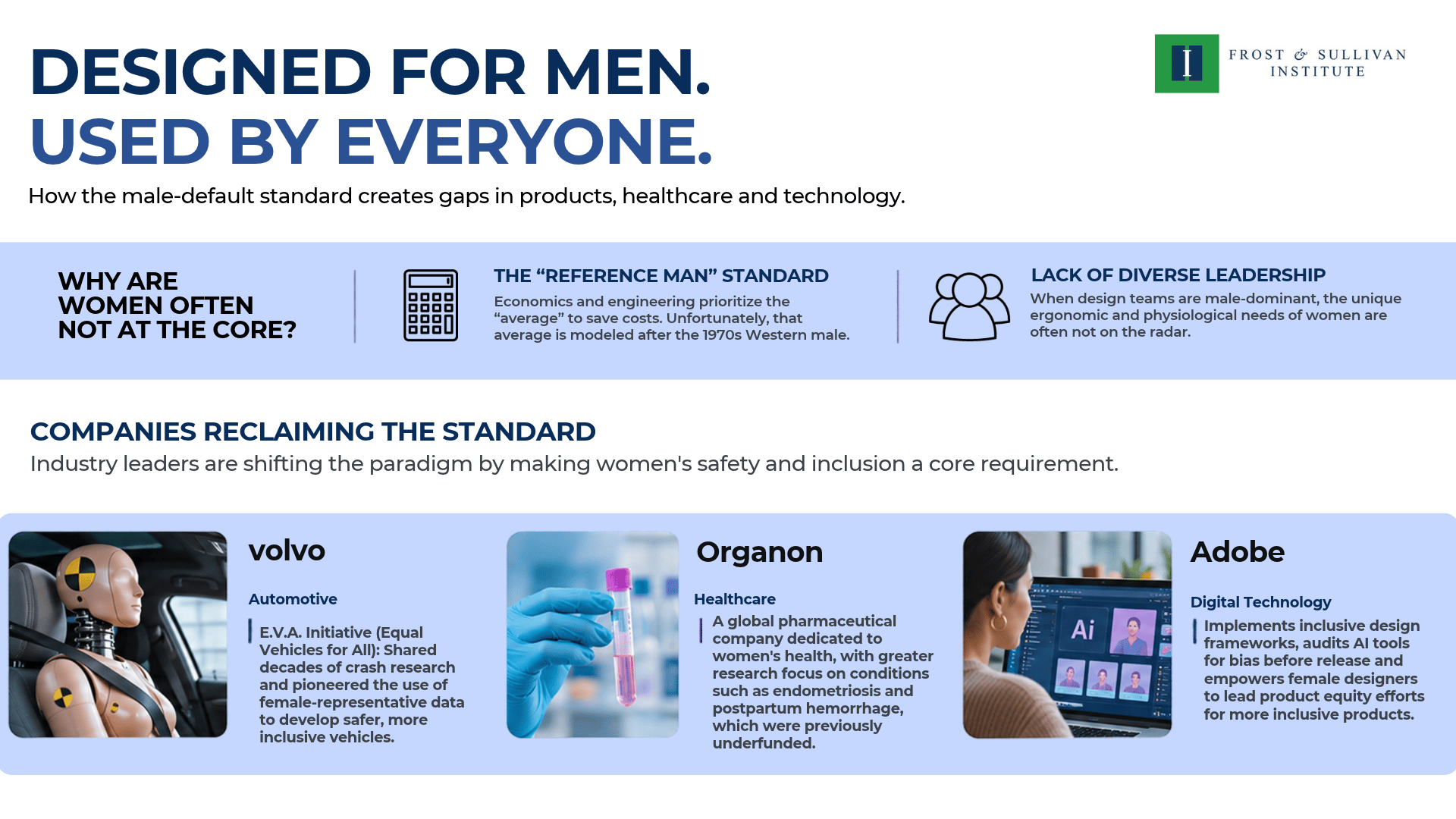
Why are Women Not at the Core?
The exclusion of women is rarely a result of active malice, but it is a result of unconscious institutional habit.
- The “Reference Man” Standard: Economics and engineering prioritize the “average” to save costs. Unfortunately, that average is modeled after the 1970s Western male.
- Lack of Diverse Leadership: When design teams are male-dominant, the unique ergonomic and physiological needs of women (from the reach of a car pedal to the symptoms of a heart attack) are simply not on the radar.
Best Practices: Companies Reclaiming the Standard
While a significant gap persists inensuring equality for women and prioritizing their safetly, there are a few companies across different sectors that are leading the way. Several industry leaders are shifting the paradigm by making women’s safety a core requirement rather than an option. Here are some of the companies and their best practices-
Through their “E.V.A. Initiative” (Equal Vehicles for All), since 2019 Volvo shared over 40 years of crash research with the global industry. They were pioneers in using female-representative data to develop the WHIPS (Whiplash Protection System), which protects both sexes equally. This is a huge breakthrough in the automotive industry where women are often overlooked.
- Organon (Healthcare)
A spinoff from Merck since 2021, Organon is one of the few global pharmaceutical companies dedicated solely to Women’s Health. They have shifted research focus toward conditions that disproportionately affect women, such as endometriosis and postpartum hemorrhage, which were previously underfunded. This is a significant progress in womens healthcare as it is severely underfunded and requires a lot of research and progress in the surrent times. All healthcare services and products being directed for men has left a big gap that organon is trying to fill.
- Adobe (Digital Technology)
Adobe has implemented inclusive design frameworks that audit AI tools for gender and racial bias before release and has led the way in making women cented design the norm. They actively hire female designers to lead “Product Equity” teams, ensuring that interface ergonomics and algorithm logic are built for a diverse user base from day one. Instead of following a standard male format or following the rules and designes approved by majority men, adobe has shifted its focus on equality and promoted inclusive design. This inclusivity which should have been the standard, is a breakthrough in the digital technology sector.
Conclusion
The continued exclusion of women from design, research, and technology development shows how deeply the “male default” is embedded in many systems that shape everyday life. From higher injury risks in car crashes and overlooked medical research to biased algorithms in digital technologies, the consequences of ignoring women’s physiological and social realities are clear and measurable. As societies rely more on data and automated systems, these gaps risk becoming even more entrenched if institutions fail to address them. However, emerging efforts by companies and researchers show that change is possible when women’s needs are considered from the beginning rather than added later. Designing with women in mind does not disadvantage men; instead, it produces safer, more accurate, and more inclusive systems for everyone. Moving forward, treating women as a central user group rather than an exception is essential for building technologies, policies, and infrastructures that are fair, effective, and truly representative of society.
Blog by Shreya Ghimire,
Senior Research Analyst, Frost & Sullivan Institute